


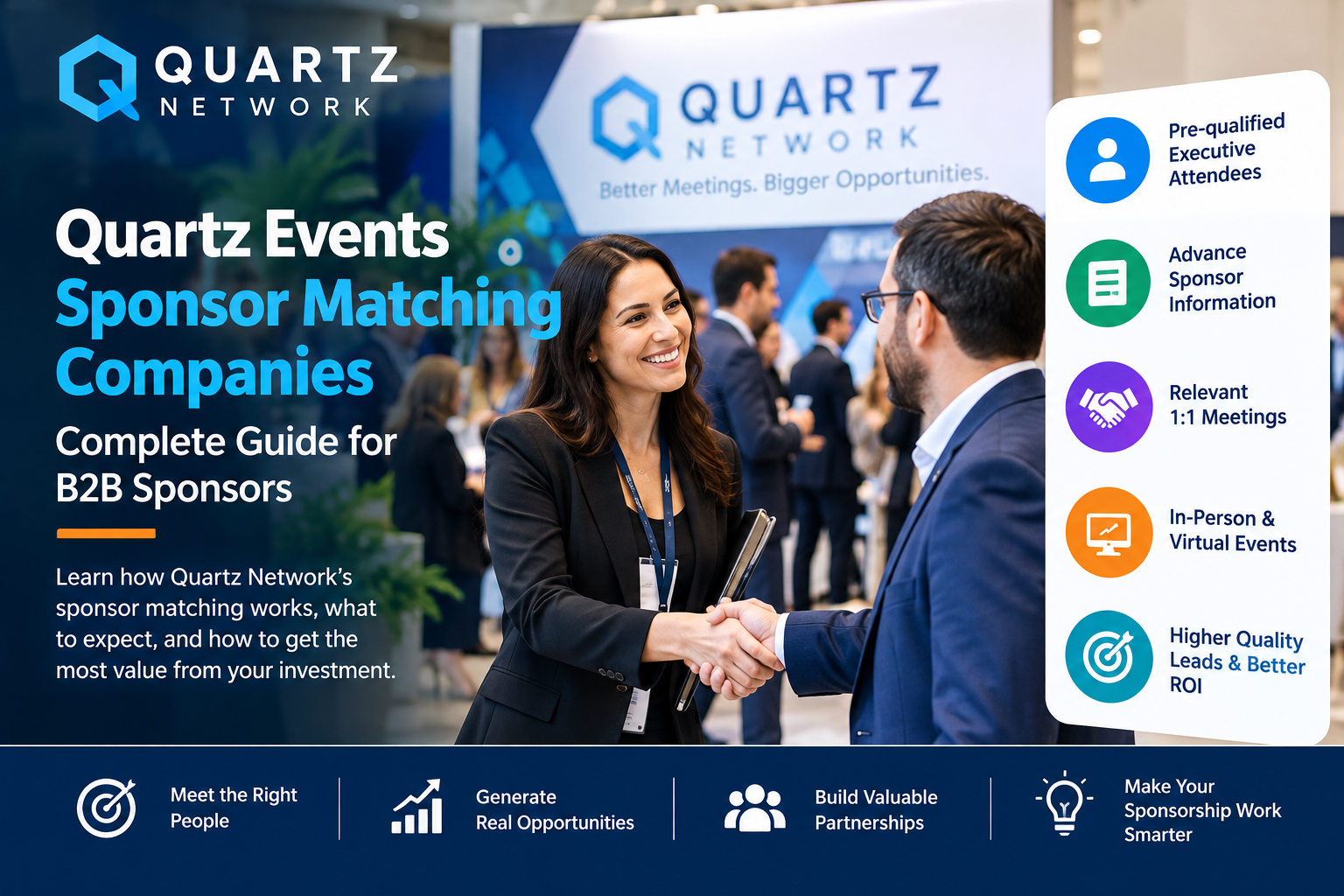
Quartz Events Sponsor Matching Companies: Complete Guide for B2B Sponsors
Quartz events sponsor matching companies is a search phrase that can be confusing at first. It may sound like the name of a group of companies that match event organizers with sponsors. In practice, however, the phrase is most closely associated with the sponsor-matching and executive-meeting model used by Quartz Network, formerly known as Quartz Events.
The idea is simple: instead of sending sales teams into a large conference and hoping they happen to meet the right people, a meeting-based event creates more targeted introductions between solution providers and senior business decision-makers.
For B2B companies, that difference can be significant.
A booth may generate hundreds of conversations, but only a fraction may involve people who have purchasing authority or an active business problem. A curated meeting, on the other hand, starts with a reason for both sides to talk.
This guide explains what quartz events sponsor matching companies means, how the Quartz Network model works, what sponsors can expect, how to measure ROI, and what businesses should check before investing in this type of event.
What Are Quartz Events Sponsor Matching Companies?
The term quartz events sponsor matching companies generally refers to the sponsor-matching concept surrounding Quartz Network and similar B2B event platforms.
Quartz Network describes its events as meeting-based B2B experiences designed to put solution providers in front of senior decision-makers. Sponsors receive information about prospective attendees before meetings and can use that information to build a more relevant meeting schedule.
This is different from conventional event sponsorship.
A traditional conference might sell:
- Exhibition booths
- Logo placement
- Speaking opportunities
- Event signage
- Sponsored sessions
- Networking access
- Promotional packages
Those benefits can be valuable, but the sponsor generally has to create its own conversations.
A matching-based event puts greater emphasis on who the sponsor meets and whether those people fit its ideal customer profile.
For example, a cybersecurity vendor would benefit more from conversations with technology and security executives facing relevant security challenges than from hundreds of random booth visitors.
That is the central idea behind sponsor matching.
Quartz Events and Quartz Network: What Is the Difference?
Another reason this keyword can be confusing is the name.
Quartz Events became part of Clarion Events after Clarion announced its acquisition of the California-based executive-summit business in 2020. The business now operates publicly as Quartz Network.
So when people search for Quartz Events sponsor matching companies, they may be referring to the older Quartz Events name while researching the current Quartz Network business.
Quartz Network focuses on executive-oriented events covering different areas of business, including technology, finance, marketing, human resources, supply chain, procurement and other corporate functions.
Its sponsorship offering is built around connecting solution providers with senior professionals rather than relying exclusively on exhibition-floor traffic.
How Quartz Network Sponsor Matching Works
The matching process is designed to make business meetings more purposeful.
1. Executive attendees are qualified
Quartz Network says its events are invitation-oriented and that attendees are vetted before participating. Its sponsorship materials state that its audience consists of senior-level decision-makers with buying power.
This matters because seniority alone is not enough.
A senior executive who has no need for your product is not necessarily a valuable prospect. The real value comes from combining seniority with relevance.
2. Sponsors receive information before the event
One of the major advantages of the model is advance information.
Quartz Network says sponsors receive extensive information about prospective customers before meetings. Sponsors can then select people they believe are most relevant and build a meeting schedule around those choices.
This gives sales teams an opportunity to research the organization and prepare questions before the conversation begins.
3. Meetings are arranged around potential relevance
The goal is not simply to put two companies in the same room.
The objective is to create a reason for the meeting.
A software company selling supply-chain analytics, for example, would ideally want to speak with an executive responsible for supply-chain visibility, forecasting, procurement or logistics transformation.
That creates a much stronger starting point than an unplanned introduction.
4. Meetings can happen in person or online
Quartz Network’s current sponsorship information says its events are held both in person and virtually, with programs serving audiences in the United States and United Kingdom.
That gives companies more flexibility when deciding how to reach their target market.
Why Sponsor Matching Is Different From Traditional Conferences
The biggest difference is intent.
At a traditional trade show, a company might attract visitors because of its booth location, branding, product demonstration or promotional offer.
But foot traffic does not automatically equal sales opportunities.
With a sponsor-matching model, the conversation starts with greater context.
Consider two scenarios.
Scenario A: Traditional booth
A vendor spends three days at a conference. Hundreds of people stop at the booth. The sales team collects business cards and later determines which contacts are actually relevant.
Scenario B: Curated meetings
The vendor receives information about potential attendees before the event, selects relevant executives and prepares for scheduled conversations.
Neither model guarantees revenue, but the second model can reduce wasted sales time because the team enters the event with a clearer target.
What Types of Companies Can Benefit?
Quartz-style event sponsorship can be particularly interesting for companies selling complex B2B products or services.
Examples include:
- Enterprise software
- Cybersecurity solutions
- Cloud platforms
- Data and analytics services
- AI solutions
- HR technology
- Financial technology
- Supply-chain technology
- Procurement platforms
- Marketing technology
- Consulting services
- Business transformation solutions
- Professional services
These businesses often have longer sales cycles and need conversations with specific decision-makers.
A company selling a complex enterprise platform may gain little from 500 casual visitors but significant value from several conversations with executives actively evaluating solutions.
The Importance of Ideal Customer Profile Matching
One of the most important factors in evaluating quartz events sponsor matching companies is the quality of the match.
Before sponsoring an event, a business should clearly define its ideal customer profile.
Ask:
- Which industries do we sell to?
- What company size is ideal?
- Which job titles make purchasing decisions?
- Which geographic markets matter?
- What problems usually trigger a buying process?
- What technologies are prospects already using?
- What budget range is realistic?
- How long is our typical sales cycle?
The more specific these answers are, the easier it becomes to evaluate whether an event is worthwhile.
For example, saying “we sell to businesses” is too broad.
Saying “we sell cybersecurity software to mid-market and enterprise organizations where CISOs and CIOs are responsible for security modernization” is much more useful.
What Should Sponsors Expect From a Quartz Event?
Sponsors should think beyond the number of meetings.
A successful event should produce useful business conversations.
Before attending, sales teams should prepare:
Research
Understand each selected executive and their organization.
Questions
Prepare questions around business challenges rather than immediately launching into a product pitch.
Relevant examples
Have customer examples or use cases that match the prospect’s industry.
Clear positioning
The team should be able to explain in simple language what problem the solution solves.
Follow-up plan
Every valuable meeting should have a defined next step.
That could be a technical demonstration, discovery call, proposal discussion, security review or follow-up meeting.
How to Measure Quartz Events Sponsor Matching ROI
One of the biggest mistakes companies make with event sponsorship is measuring success only through attendance.
A better approach is to track the complete sales funnel.
Meeting-to-opportunity rate
How many meetings became genuine sales opportunities?
Opportunity value
What is the estimated value of those opportunities?
Cost per qualified opportunity
Divide the total event investment by the number of qualified opportunities generated.
Pipeline generated
Measure the total potential revenue associated with event-influenced opportunities.
Closed revenue
Eventually, compare the event’s cost against actual revenue generated.
Customer acquisition cost
If the event consistently produces customers, compare the acquisition cost with other channels such as paid advertising, outbound sales and trade shows.
This provides a much clearer picture of whether the sponsorship is working.
Quartz Network’s Published Sponsor Statistics
Quartz Network publishes several performance figures on its sponsorship website.
Its current materials state that 97% of sponsors would recommend a Quartz Network event to their peers, while 80% of Fortune 500 companies have attended a Quartz Network event. The company also states that its events are designed around senior-level decision-makers with buying power.
These numbers are useful when researching the offering, but sponsors should remember that they are company-published claims, not independent industry benchmarks.
The best question is therefore not simply, “What percentage of sponsors recommend the event?”
A better question is:
“What results can a company with my target audience and sales cycle reasonably expect?”
Prospective sponsors should request information relevant to their specific industry and target buyer.
Questions to Ask Before Sponsoring
Before signing an agreement with Quartz Network or another sponsor-matching provider, ask detailed questions.
Who will I meet?
Request information about industries, job functions, company sizes and seniority.
How are meetings selected?
Find out whether sponsors select prospects themselves, whether the organizer recommends matches, or whether both processes are involved.
What happens if a meeting is canceled?
Understand the provider’s policy for cancellations, substitutions and missed meetings.
What information is provided beforehand?
More context generally allows sales teams to prepare better.
What is included in the sponsorship fee?
Clarify meetings, speaking opportunities, branding, networking, travel-related elements and other benefits.
How is success measured?
A strong provider should be able to explain what sponsors can track after the event.
Common Mistakes Sponsors Should Avoid
Even a strong matching system cannot replace good sales execution.
One common mistake is treating every scheduled meeting as a guaranteed lead.
A meeting is an opportunity to discover whether there is a business problem and whether the sponsor’s solution is relevant.
Another mistake is delivering the same generic presentation to every executive.
Senior buyers usually have limited time. A focused conversation around their priorities is more valuable than a long product demonstration.
Poor follow-up is another major problem.
A promising conversation can disappear if nobody contacts the prospect for several weeks.
The sales team should record important information immediately after every meeting and agree on the next action.
Is Quartz Sponsor Matching Worth It?
For the right B2B company, it can be worth considering.
The model is particularly attractive when a business sells a high-value solution and needs access to senior decision-makers.
It may be less attractive for companies that depend mainly on mass-market awareness, impulse purchases or very large volumes of low-value leads.
The key is alignment.
If the event audience matches your ideal customer profile, the meeting format can potentially save sales teams time and create more focused conversations.
If the audience is poorly matched, even a sophisticated matchmaking system will not solve the underlying problem.
Quartz Events Sponsor Matching Companies vs. Generic Sponsor Marketplaces
It is also important to understand that not every sponsor-matching company operates like Quartz Network.
Some platforms help event organizers find brands willing to provide financial sponsorship.
Others are event-management software platforms.
Some focus on attendee matchmaking.
Others operate hosted-buyer programs or executive networking events.
These models should not be treated as identical.
When comparing providers, identify what you are actually buying:
Sponsor discovery?
Event technology?
Audience access?
Qualified meetings?
Lead generation?
Brand exposure?
Once that distinction is clear, comparing costs and expected results becomes much easier.
The Future of B2B Event Sponsor Matching
The broader events industry is moving toward more data-driven matchmaking.
Event organizers increasingly have access to attendee profiles, meeting preferences, business interests and engagement information. AI and recommendation technology can potentially make these systems more sophisticated.
But technology is only part of the equation.
Good matching still depends on accurate information.
If an attendee profile is incomplete, the system has limited information with which to make a recommendation. If a sponsor defines its target market too broadly, matching quality can suffer as well.
Human judgment therefore remains important.
The strongest approach is likely to combine technology, detailed attendee information and experienced event teams.
Final Thoughts on Quartz Events Sponsor Matching Companies
Quartz events sponsor matching companies is best understood as a search term connected to a broader B2B event and sponsor-matching model, with Quartz Network being the most direct reference.
The concept is built around a straightforward business problem: helping solution providers spend less time searching for random contacts and more time speaking with relevant decision-makers.
Quartz Network’s current sponsorship model emphasizes senior executives, advance attendee information, handpicked meetings and in-person or virtual events.
For sponsors, the biggest opportunity is not simply visibility. It is the possibility of creating focused business conversations with people who may have relevant responsibilities, challenges or purchasing authority.
But no event can guarantee that every meeting becomes a sale.
The smartest approach is to evaluate audience quality, meeting relevance, sponsorship cost, sales-cycle fit and measurable pipeline results before committing.
In other words, don’t ask only whether an event offers more meetings.
Ask whether it offers better meetings with the right people.
That is ultimately what makes sponsor matching valuable.
