


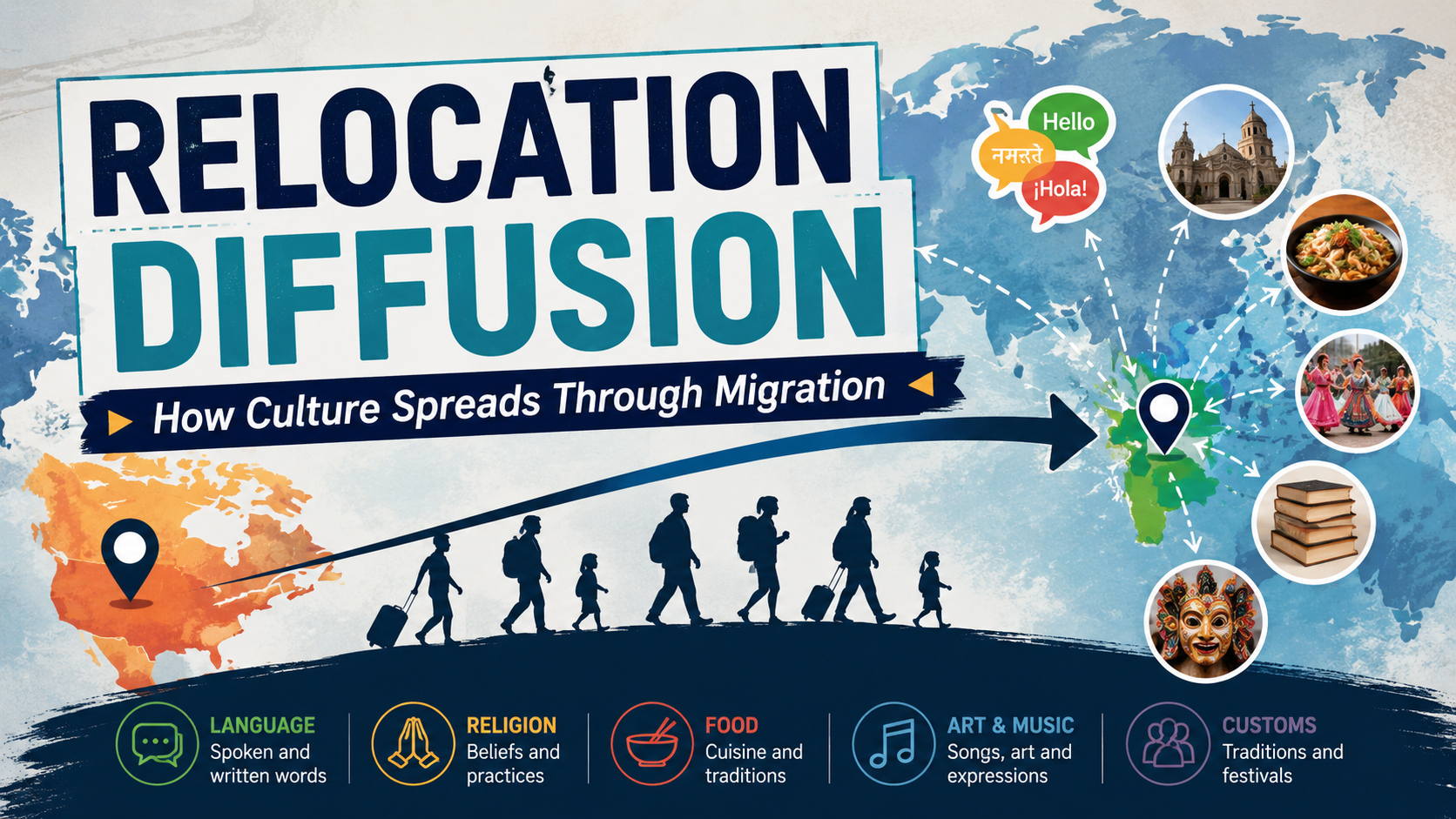
Relocation Diffusion: What Does It Mean?
Relocation diffusion is the spread of an idea, cultural practice, language, religion, technology, or other characteristic from one place to another because people physically move from their original location to a new one.
In simple terms, people move, and they take their culture, knowledge, beliefs, and habits with them.
This concept is important in human geography because migration is one of the major ways that cultures and ideas travel across regions. When a group of people settles in a new area, the traditions they bring can influence the local population and become part of the cultural landscape.
For example, when immigrants move from one country to another, they may bring their language, food, religious practices, music, clothing styles, and celebrations. Over time, some of these characteristics may become familiar to the surrounding population.
Unlike some other forms of diffusion, relocation diffusion depends heavily on physical movement. If people do not move, the particular cultural trait may not spread through relocation diffusion.
How Does Relocation Diffusion Work?
The process is relatively straightforward.
First, an idea or cultural characteristic exists in a particular place. People living there practice or use it. When some of those people migrate to another location, they carry that characteristic with them.
Once they establish themselves in the new location, the characteristic can continue there.
A simplified process looks like this:
Original location → Migration → New location → Cultural characteristic appears or grows
Consider food as an example. Imagine a family moves from Italy to the United States and continues preparing traditional Italian dishes. If they open a restaurant, the food reaches customers outside their immediate family. Those customers may then develop an interest in Italian cuisine.
The original culture has therefore crossed a geographic boundary because people moved.
This is the central idea behind relocation diffusion.
Key Characteristics of Relocation Diffusion
Several features make relocation diffusion different from other forms of cultural diffusion.
1. It involves physical movement
The most important characteristic is migration. Individuals or groups move from one place to another and carry cultural traits with them.
2. The source population changes location
The people responsible for spreading the cultural trait are no longer limited to their original location. They establish themselves somewhere else.
3. Culture can spread across large distances
Relocation diffusion can connect places that are thousands of miles apart. International migration is a particularly powerful example.
4. The original culture may continue at the source
Migration does not necessarily mean that a cultural practice disappears from its original location. Instead, it can exist in both the old and new locations.
5. Local cultures can influence the imported culture
The cultural trait brought by migrants may change after reaching its new environment. It can mix with local traditions and create new cultural forms.
Examples of Relocation Diffusion
Relocation diffusion can be seen throughout history and in modern society.
Migration and Language
Language is one of the clearest examples.
When people migrate to another country, they often continue speaking their native language at home or within their community. Over generations, this can create multilingual neighborhoods and communities.
For example, Spanish-speaking migrants who settle in the United States may maintain Spanish within their families and communities. Spanish can therefore remain widely used even though the speakers are living outside the language’s original geographic region.
The same process has occurred with languages brought to many parts of the world through migration.
Religion
Relocation diffusion has played a major role in the geographic distribution of religions.
Religious followers have historically migrated, traveled, established communities, and settled in new regions. As they moved, they carried their beliefs and religious practices with them.
For instance, migration has helped establish religious communities far from the regions where particular traditions first developed.
Religious buildings, festivals, dietary practices, and places of worship can become visible signs of this type of cultural movement.
Food and Cuisine
Food is another everyday example.
Immigrants frequently bring recipes and cooking traditions from their home countries. Restaurants, markets, bakeries, and family businesses can introduce these foods to people in their new communities.
Italian, Chinese, Indian, Mexican, Korean, Middle Eastern, and many other cuisines have become popular far beyond their places of origin.
The food itself may also change. Local ingredients and preferences can influence recipes, producing versions that are different from those traditionally prepared in the original homeland.
This demonstrates how relocation diffusion can interact with other forms of cultural change.
Music
Music also travels when people migrate.
Musicians and communities may bring instruments, rhythms, musical traditions, and performance styles to new regions. Over time, these traditions can influence local artists.
Many modern musical genres reflect combinations of cultural influences that developed through migration and cultural exchange.
Clothing and Traditions
Migrants may continue wearing traditional clothing or celebrating holidays from their homeland.
Community festivals are especially visible examples. A cultural festival held in a new country may preserve traditions from the group’s original location while also attracting people from other backgrounds.
As participation increases, elements of those traditions can become familiar beyond the original immigrant community.
Relocation Diffusion vs. Expansion Diffusion
One of the most important distinctions in human geography is the difference between relocation diffusion and expansion diffusion.
Relocation diffusion occurs when people physically move and carry a cultural characteristic to a new location.
Expansion diffusion occurs when an idea spreads outward from its original location while the original source remains important.
For example, if a group of migrants moves to another country and brings its religious practices with them, that is relocation diffusion.
If people living in neighboring communities adopt a new cultural trend without the original population moving, that is more closely associated with expansion diffusion.
Simple Comparison
| Feature | Relocation Diffusion | Expansion Diffusion |
|---|---|---|
| Main mechanism | People move | Ideas spread outward |
| Physical migration | Usually essential | Not necessarily required |
| Original location | May continue the trait | Usually remains an important source |
| Common examples | Migration, diaspora communities | Trends, ideas, technologies |
| Geographic spread | Can jump long distances | Often spreads across connected areas |
Understanding this difference makes it easier to identify relocation diffusion in geography questions.
Relocation Diffusion vs. Contagious Diffusion
Relocation diffusion can also be compared with contagious diffusion.
Contagious diffusion occurs when something spreads rapidly from person to person or place to place, similar to the way an infectious disease can spread through direct contact.
A trend spreading through a neighborhood because people interact with one another is an example of contagious diffusion.
Relocation diffusion works differently. The key factor is the movement of people from one geographic location to another.
However, the two processes can occur together.
For example, migrants may introduce a cultural practice to a new city through relocation diffusion. People in that city may then adopt the practice through contagious diffusion.
Why Migration Is Important to Relocation Diffusion
Migration is the engine that drives relocation diffusion.
People migrate for many reasons, including employment, education, family reunification, political conditions, economic opportunities, conflict, environmental pressures, and personal preferences.
Regardless of the reason for migration, people usually carry parts of their cultural identity with them.
This can include:
- Language
- Religion
- Food
- Music
- Family traditions
- Clothing
- Art
- Social customs
- Skills and knowledge
- Agricultural practices
As migrant populations establish communities, these characteristics become part of the cultural geography of their new locations.
Historical Examples of Relocation Diffusion
Human history contains countless examples of relocation diffusion.
Large migration movements have transformed the cultural landscapes of entire continents. Explorers, settlers, merchants, workers, refugees, and families have all contributed to the movement of cultural characteristics.
The movement of populations from Europe to other parts of the world, for example, contributed to the spread of European languages, religions, political traditions, agricultural practices, and architectural styles.
Likewise, forced migrations have had enormous cultural consequences. Enslaved Africans were forcibly transported across the Atlantic, bringing languages, musical traditions, food practices, religious influences, and artistic traditions that later became important parts of cultures in the Americas.
These examples show that relocation diffusion is not limited to voluntary migration.
Modern Examples of Relocation Diffusion
Relocation diffusion remains highly visible today because international migration is common.
Large cities often contain neighborhoods where people from particular cultural backgrounds live, work, worship, and operate businesses.
A single metropolitan area may contain restaurants, grocery stores, religious centers, cultural organizations, and festivals representing dozens of different countries.
Digital communication makes the process even more interesting. Migrants can now maintain close connections with their home countries while simultaneously participating in their new societies.
As a result, cultural practices can move with people and remain connected across national borders.
Relocation Diffusion and Globalization
Globalization has increased opportunities for cultural interaction.
People travel internationally for work, education, tourism, and business. International companies also move employees between countries.
When people relocate, they bring knowledge and cultural practices into new environments.
This can contribute to increasingly diverse cities and workplaces.
At the same time, globalization does not necessarily erase local cultures. Instead, it can create new combinations.
A restaurant may combine traditional recipes with local ingredients. A musician may blend sounds from several cultural backgrounds. A family may speak one language at home while using another at school or work.
These examples show that cultural diffusion can produce hybrid identities rather than simply replacing one culture with another.
The Role of Diaspora Communities
Diaspora communities are particularly important to understanding relocation diffusion.
A diaspora is a population dispersed from its traditional homeland to different geographic locations.
Members of diaspora communities often maintain connections to their original culture through language, religion, food, celebrations, family traditions, and social networks.
At the same time, they interact with the cultures around them.
This creates a two-way process. Migrants influence their new communities, while their new environments influence the migrants.
Over time, diaspora communities can become important centers for cultural exchange.
Is Relocation Diffusion Always Successful?
No. A cultural characteristic does not automatically become popular after being introduced to a new location.
Several factors influence whether diffusion occurs successfully.
Acceptance: Local populations may accept or reject the new cultural practice.
Similarity: Cultural traits that are compatible with existing customs may spread more easily.
Population size: A larger migrant community may have more opportunities to maintain its traditions.
Communication: Schools, businesses, social media, and community organizations can help cultural traits spread.
Government policies: Immigration and integration policies can influence how easily communities establish themselves.
Economic conditions: Successful businesses can provide additional ways for cultural practices to reach wider audiences.
Because of these factors, relocation diffusion can produce very different outcomes in different places.
Why Relocation Diffusion Matters in Human Geography
Relocation diffusion helps geographers understand why cultures are not restricted to specific geographic boundaries.
Languages, religions, cuisines, technologies, and traditions often appear far from their historical points of origin because people have moved.
The concept also helps explain cultural diversity within cities and countries.
When researchers study migration patterns alongside cultural landscapes, they can better understand how communities form and how cultural characteristics change over time.
For students, learning relocation diffusion is especially useful because it connects several major topics in geography, including migration, population, culture, globalization, and spatial interaction.
Frequently Asked Questions About Relocation Diffusion
What is relocation diffusion in simple terms?
Relocation diffusion is the spread of a cultural trait or idea when people physically move from one place to another and carry that trait with them.
What is an example of relocation diffusion?
Immigrants bringing their language, religion, food, or traditions to a new country are common examples of relocation diffusion.
Is migration necessary for relocation diffusion?
Physical movement of people is the defining feature of relocation diffusion. The cultural trait spreads because the people who possess it relocate.
How is relocation diffusion different from expansion diffusion?
Relocation diffusion involves people moving to a new place. Expansion diffusion occurs when an idea spreads outward while the original source remains in place.
Can relocation diffusion change a culture?
Yes. Cultural traits brought by migrants can mix with local traditions, creating new practices, foods, languages, music, and identities.
Why is relocation diffusion important?
It helps explain how cultural characteristics spread across geographic boundaries and why communities around the world often contain influences from many different places.
Final Thoughts
Relocation diffusion is one of the clearest examples of how human movement changes the cultural landscape.
Whenever people move, they often take more than their belongings with them. They carry languages, beliefs, recipes, music, customs, knowledge, and traditions. Once these cultural characteristics reach a new location, they can be preserved, adapted, shared, or combined with local practices.
From immigrant neighborhoods and international cuisines to religious communities and multilingual cities, relocation diffusion can be seen in everyday life.
Understanding this concept also makes larger geographic patterns easier to recognize. Migration is not simply the movement of people from one place to another; it can also be a powerful mechanism for the movement and transformation of culture.
For students of human geography, relocation diffusion provides a useful framework for understanding how people connect distant places and how those connections continue to shape societies over time.
