


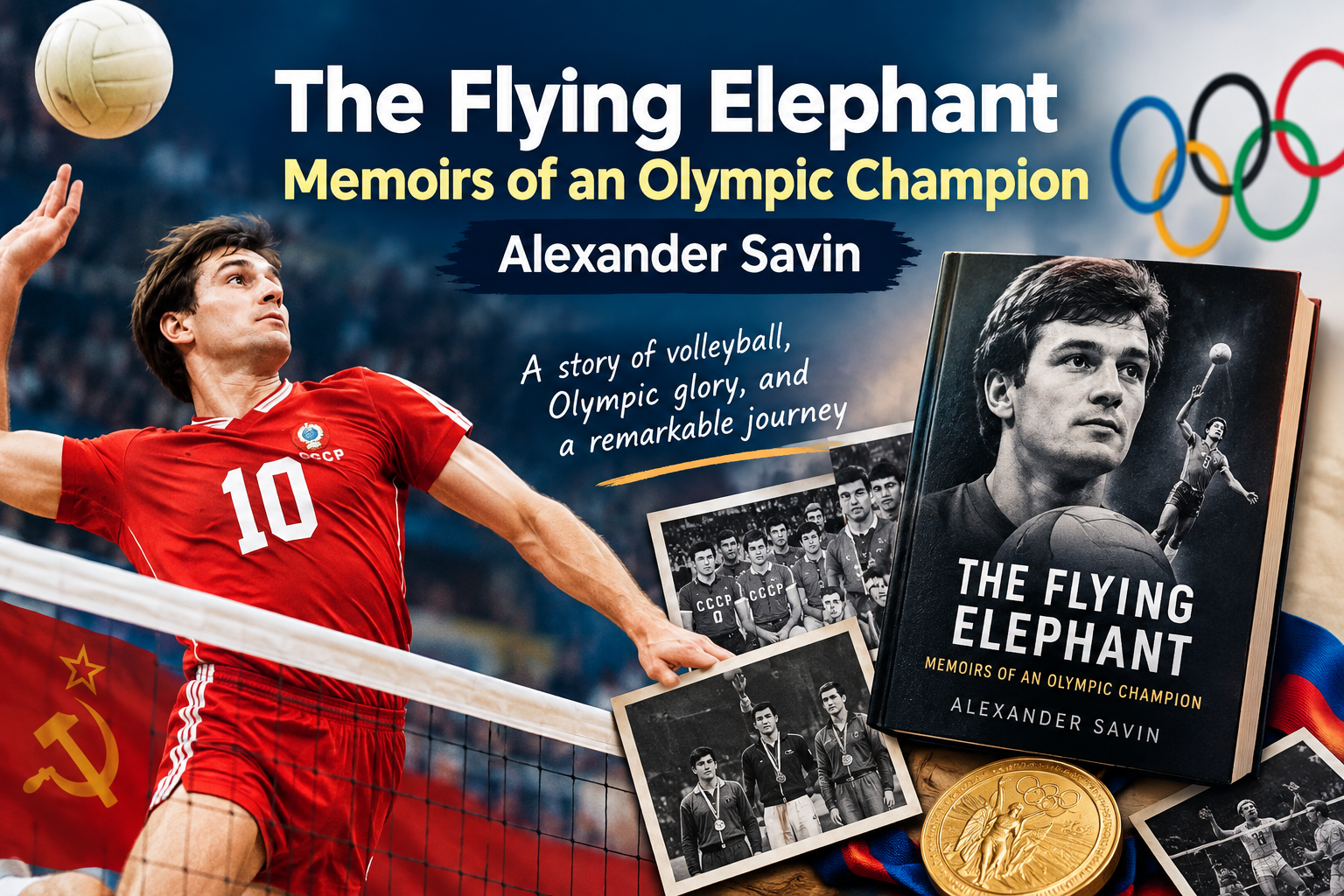
The Flying Elephant Memoirs of an Olympic Champion Alexander Savin: An Introduction
The flying elephant memoirs of an olympic champion alexander savin introduces readers to the remarkable sporting life of Alexander Savin, one of the best-known volleyball players of the Soviet era.
For many sports fans, an Olympic medal represents the final destination. For Savin, however, the medal was only one part of a much longer story involving years of training, international competition, teamwork, disappointment, pressure, and personal development.
The Flying Elephant: Memoirs of an Olympic Champion offers readers an opportunity to look at elite volleyball from the perspective of someone who actually experienced it. Rather than treating Olympic success as something that happens overnight, the memoir explores the work and circumstances that exist behind the spotlight.
The English edition is presented as a substantial 514-page memoir and includes more than 240 photographs from private collections and archives, giving the book an additional historical dimension.
That combination of personal memories and visual history makes the book particularly interesting for volleyball followers, Olympic-history readers, coaches, athletes, and anyone curious about Soviet-era international sport.
Who Was Alexander Savin?
Alexander Savin was a Soviet volleyball player who competed at the highest level of international volleyball.
His Olympic career included two particularly important moments. He won a silver medal at the 1976 Montreal Olympics and later became an Olympic champion with the Soviet team at the 1980 Moscow Olympics.
That progression is important when understanding his memoir.
Winning Olympic gold can easily make a career appear straightforward when viewed from a distance. Savin’s Olympic story was more complicated. He experienced the disappointment of falling short before eventually reaching the top of the podium.
That makes his journey particularly relevant to readers interested in resilience.
His career was also connected to the powerful Soviet volleyball system, including the national team and CSKA Moscow. The period in which he competed was one of intense international competition, with volleyball becoming an important part of global sporting culture.
What Is The Flying Elephant: Memoirs of an Olympic Champion About?
At its core, The Flying Elephant is a sports memoir about Alexander Savin’s life and career.
But describing it simply as a book about volleyball would undersell its subject.
The memoir explores several interconnected areas:
- Alexander Savin’s development as an athlete
- Professional volleyball training
- Olympic competition
- Team relationships
- The pressure surrounding elite sport
- Soviet-era volleyball
- International competition
- Personal sacrifice
- Coaching and life after playing
- The human side of sporting success
The book is therefore useful to readers who want more than statistics and medal tables.
It attempts to put the reader closer to the athlete’s experience.
Published descriptions of the English edition also emphasize its extensive photographic material, with more than 240 images documenting different aspects of volleyball history.
Why Is the Book Called “The Flying Elephant”?
The title is probably the first thing that makes potential readers curious.
Why would the memoir of an Olympic volleyball champion be called The Flying Elephant?
The phrase works particularly well as an image for volleyball. An elephant traditionally represents size, power, and physical strength, while “flying” suggests movement, elevation, and something that appears almost impossible.
Accounts describing Savin and the memoir connect the nickname with the contrast between his powerful physical presence and his ability to jump and move effectively on the volleyball court.
There is also a broader metaphor in the title.
Elite athletes are regularly asked to accomplish things that appear unrealistic to ordinary people. They must train beyond normal limits, perform under enormous pressure, and repeat difficult movements until they become instinctive.
In that sense, a “flying elephant” becomes an appropriate symbol for an athlete doing something that seems impossible until disciplined preparation makes it possible.
Savin’s Olympic Journey
One of the most interesting aspects of Alexander Savin’s story is that his Olympic legacy includes both disappointment and triumph.
At the 1976 Montreal Olympics, Savin and the Soviet volleyball team earned silver.
Four years later, the story changed.
At the 1980 Moscow Olympics, the Soviet team won gold, giving Savin the Olympic championship that became one of the defining achievements of his career.
That contrast gives the memoir a useful lesson about competitive sport.
Athletes are rarely defined by one result.
A silver medal at the Olympics is an extraordinary achievement, but elite competitors often experience it differently. For someone who wants to reach the top, second place can become motivation for another cycle of preparation.
Savin’s Olympic path demonstrates how disappointment can become part of a larger career rather than the end of it.
The World Behind Soviet Volleyball
The memoir is also valuable because Savin competed during an important period of international sports history.
Soviet sport was heavily organized and supported by a broader state system. Athletes were expected to train at extremely high levels, while international victories carried significance beyond the individual competitor.
Volleyball was one of the sports in which Soviet athletes developed a powerful international reputation.
For modern readers, this historical context is important.
Professional sports today are surrounded by social media, commercial sponsorships, sports science content, instant statistics, and constant online coverage. Savin’s generation competed in a very different environment.
There was no modern digital ecosystem documenting every training session or tournament.
A memoir from an athlete who lived through that period therefore has value beyond its personal story.
It can help preserve memories of a sporting culture that has changed dramatically.
What Readers Can Learn About Elite Training
One of the strongest themes associated with The Flying Elephant is the discipline behind high-level performance.
Olympic success is often presented through its most visible moments: the final match, the medal ceremony, the national anthem, and the celebration.
The difficult part happens long before those moments.
Athletes spend years repeating fundamentals, correcting weaknesses, building physical strength, studying opponents, and learning how to function within a team.
That is particularly important in volleyball.
Unlike individual sports, volleyball requires players to coordinate constantly. A technically gifted player cannot succeed alone. Timing, communication, positioning, trust, and tactical understanding all matter.
Savin’s career demonstrates how individual ability becomes more valuable when combined with a strong team structure.
Teamwork Is at the Center of Volleyball
A useful lesson from Alexander Savin’s career is that Olympic success is rarely an individual achievement.
Even when one player receives public attention, volleyball is fundamentally a team sport.
Players depend on one another for:
- Defensive coverage
- Blocking
- Setting
- Attacking
- Communication
- Tactical adjustments
- Emotional support
A middle blocker, for example, has responsibilities that affect both attack and defense.
The best teams are not simply collections of talented players. They are groups capable of functioning together under pressure.
That makes Savin’s memoir potentially valuable for coaches and young athletes as well as ordinary sports fans.
The Human Side of Olympic Success
Another reason sports memoirs remain popular is that statistics cannot tell the entire story.
A medal can tell us who won.
It cannot tell us how an athlete felt before the competition.
It cannot fully explain the anxiety surrounding a major match, the physical exhaustion after years of preparation, or the relationships formed inside a team.
This human element is where memoir becomes particularly useful.
The flying elephant memoirs of an olympic champion alexander savin is therefore interesting not simply because Savin won Olympic gold, but because his experiences provide a personal perspective on what existed behind that achievement.
The distinction matters.
A history book might tell readers what happened.
A memoir can help explain what those events meant to the person who experienced them.
More Than a Volleyball Book
Although volleyball is at the heart of the memoir, the book can appeal to a much wider audience.
Readers interested in Olympic history can explore the experience of an athlete who competed at two Olympic Games.
Readers interested in sports psychology can consider the pressure and expectations surrounding elite performance.
Coaches can find lessons about discipline and team development.
Young athletes can see why long-term progress matters more than instant results.
And readers interested in twentieth-century history can gain another perspective on international sport during the Soviet period.
That broad appeal is one of the memoir’s biggest strengths.
The Importance of Historical Photographs
The photographs are another feature worth mentioning.
The English edition is reported to contain more than 240 photographs, including material connected with training, competitions, teammates, and the wider history of the sport.
For a sports memoir, photographs can do something words cannot.
They provide visual evidence of clothing, venues, teammates, sporting equipment, and the atmosphere surrounding competitions.
For younger volleyball fans, these images can also make an earlier era of the sport easier to understand.
Instead of reading about a distant period as an abstract piece of history, readers can see elements of it.
Who Should Read The Flying Elephant?
This memoir is particularly suitable for:
Volleyball Fans
Anyone interested in the history of international volleyball will find Savin’s firsthand perspective valuable.
Olympic Sports Fans
Readers fascinated by Olympic careers can explore the journey of an athlete who experienced both silver and gold.
Athletes
Young competitors can take lessons from the emphasis on preparation, discipline, teamwork, and persistence.
Coaches
The book offers a perspective on athlete development and the culture surrounding elite competition.
Sports Historians
Savin’s memories provide a personal window into Soviet-era volleyball and international sport.
What Makes Alexander Savin’s Story Relevant Today?
The sporting world has changed considerably since Savin’s Olympic career.
Athletes now have access to advanced analytics, wearable technology, video analysis, specialized nutrition, social media, and highly developed sports-science programs.
Yet the fundamentals remain familiar.
Athletes still need discipline.
Teams still need trust.
Champions still experience pressure.
And setbacks still have to be overcome.
That is why an older Olympic story can remain relevant.
The technology surrounding sport changes quickly. Human competition does not.
Key Lessons From the Memoir
Several broad lessons stand out from Alexander Savin’s Olympic journey.
1. Success takes time.
Olympic achievement is usually the result of years of preparation rather than a sudden breakthrough.
2. Failure does not define a career.
Savin’s Olympic silver preceded his Olympic gold, demonstrating that an earlier setback can become part of a successful long-term journey.
3. Individual talent is not enough.
Volleyball requires communication and cooperation. Great teams depend on players who understand their roles.
4. Discipline creates consistency.
Natural ability may open the door, but sustained training helps an athlete remain competitive.
5. Sporting history is worth preserving.
Personal memoirs can keep memories of past generations alive in ways that statistics cannot.
Is The Flying Elephant: Memoirs of an Olympic Champion Worth Reading?
For readers interested in volleyball, Olympic history, or athlete memoirs, the book has a strong reason to be on the reading list.
Its greatest attraction is not simply the Olympic gold medal.
It is the opportunity to understand the journey behind that medal.
The combination of Savin’s personal story, Soviet volleyball history, international competition, and extensive photographic material gives the memoir a broader appeal than a conventional sports biography.
Readers expecting a modern celebrity autobiography may find the historical setting very different. But that difference is also part of the book’s appeal.
It takes readers into an era when international sport operated under very different political, cultural, and professional conditions.
Final Thoughts
The flying elephant memoirs of an olympic champion alexander savin is ultimately a story about much more than volleyball.
Alexander Savin’s career represents the long road from athletic development to Olympic competition, from disappointment to triumph, and from individual ambition to team achievement.
His Olympic medals provide the headline, but the real value of a memoir lies in everything that happened before and after those moments.
The Flying Elephant: Memoirs of an Olympic Champion gives readers a chance to look beyond the podium and consider the discipline, teamwork, pressure, history, and human experiences that shape an Olympic career.
For volleyball fans and readers interested in sports history, that perspective is what makes Alexander Savin’s story worth remembering.
Frequently Asked Questions
Who is Alexander Savin?
Alexander Savin is a former Soviet volleyball player and Olympic champion. He won Olympic silver at the 1976 Montreal Games and Olympic gold at the 1980 Moscow Games.
What is The Flying Elephant: Memoirs of an Olympic Champion?
It is Alexander Savin’s sports memoir covering his volleyball career, Olympic experiences, training, team life, and broader experiences within Soviet-era international sport.
Why is the book called The Flying Elephant?
The unusual title is associated with Savin’s combination of physical power and jumping ability on the volleyball court, while the image also works as a metaphor for achieving something that initially seems impossible.
Is The Flying Elephant about volleyball?
Yes. Volleyball is the central subject of Savin’s sporting story, but the memoir also touches on Olympic competition, teamwork, discipline, personal experiences, and sports history.
Does the book contain photographs?
The English edition is described as containing more than 240 photographs from private collections and archives.
Who would enjoy this memoir?
Volleyball fans, Olympic sports enthusiasts, athletes, coaches, sports historians, and readers interested in Soviet-era international competition are likely to find it particularly interesting.
What can athletes learn from Alexander Savin’s story?
The biggest lessons include patience, discipline, teamwork, resilience, and the importance of continuing to develop after setbacks.
Why is Savin’s Olympic story significant?
His career includes both an Olympic silver medal and a later Olympic gold medal, making his journey a useful example of how elite athletes can respond to disappointment and continue pursuing their goals.
