


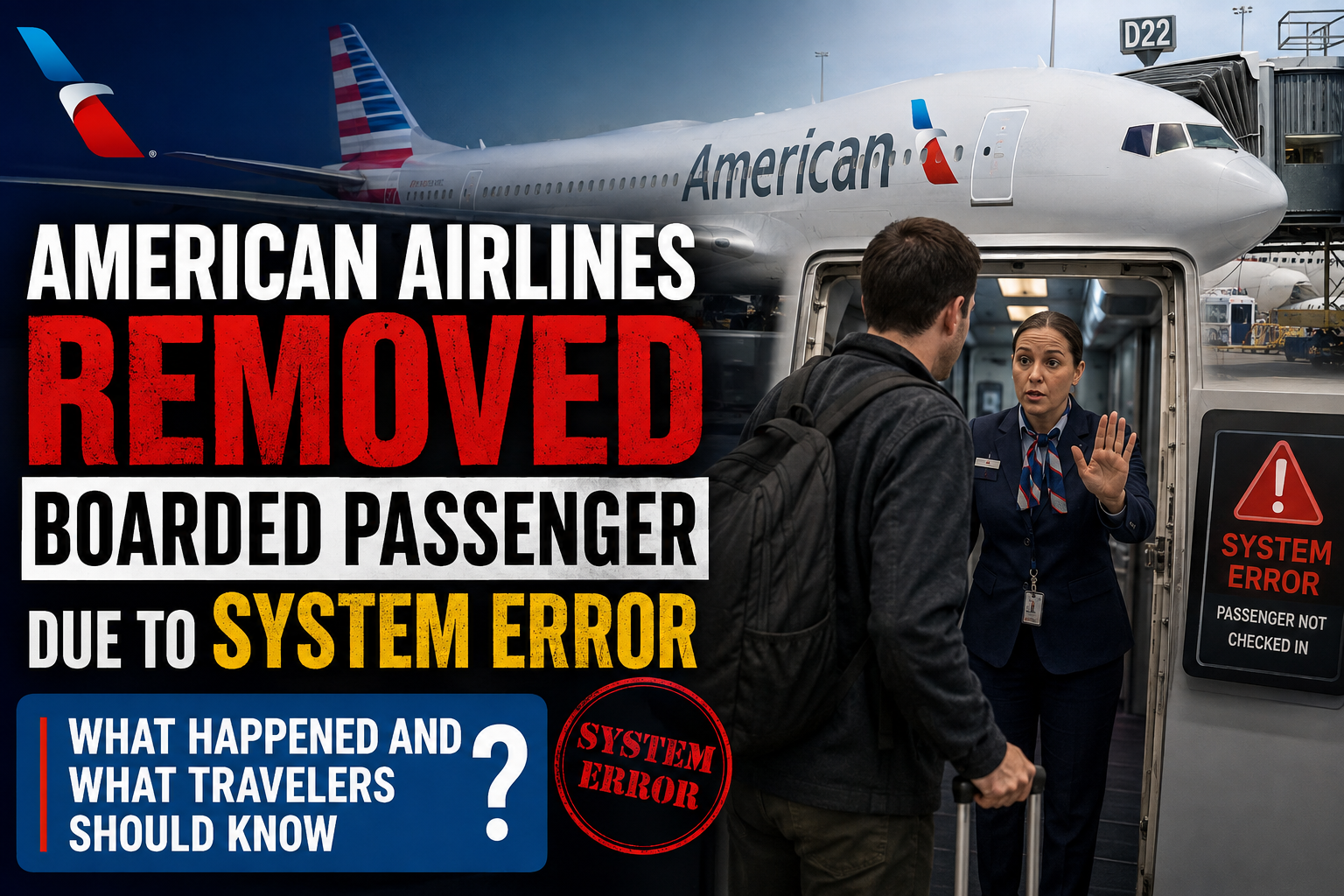
The American Airlines removed boarded passenger due to system error incident has raised fresh questions about airline technology, gate procedures and passenger rights. A traveler who had reportedly checked in, scanned a valid boarding pass and taken a seat on an American Airlines flight was later asked to leave the aircraft after the airline’s system showed that the passenger had not checked in.
The unusual incident reportedly happened at Dallas-Fort Worth International Airport (DFW) on an American Airlines flight to Austin-Bergstrom International Airport (AUS). The passenger had already boarded and was sitting in an exit-row seat when a standby traveler arrived claiming the same seat.
What followed turned a routine boarding process into a much more complicated situation.
According to aviation reports, the airline’s system did not show the passenger as checked in when the crew reviewed its information. The passenger reportedly had a valid boarding pass and had already passed through the boarding process. Nevertheless, the seat was treated as available and was given to a standby traveler.
The passenger was subsequently removed from the aircraft and rebooked on a later flight.
The story is attracting attention because it was apparently not a conventional overbooking case. Instead, the central issue was a mismatch between what actually happened at the airport and what the airline’s computer system showed.
What Happened to the American Airlines Passenger?
The reported incident involved American Airlines Flight 2324, traveling from DFW to Austin-Bergstrom International Airport.
According to Aviation A2Z, the passenger was an Executive Platinum AAdvantage member and had boarded with Group 1. They had a boarding pass that was scanned at the gate, answered questions related to sitting in an exit row and then took their assigned seat.
Everything appeared normal.
The problem emerged when a standby passenger arrived and claimed the same seat.
Flight attendants reportedly checked the information available on an iPad and discovered that the original passenger did not appear on the check-in list. That created a strange situation: a person was physically sitting in the aircraft with a boarding pass that had already been accepted, but the airline’s operational system apparently showed something different.
Instead of treating the discrepancy as a technical problem that needed to be corrected, the passenger was reportedly asked to leave the aircraft.
The passenger later traveled on another flight.
That basic sequence is what makes the story so unusual. It was not simply a case of someone arriving too late at the gate or failing to check in.
How Could a Passenger Disappear From the System?
Airline travel depends on several connected computer systems.
A reservation may begin in one system, while check-in, seat assignments, boarding passes, passenger manifests and operational information can be handled through different parts of a larger airline technology environment.
Most passengers never see this complexity.
They simply open an app, receive a boarding pass, scan it at the airport and get on the plane.
But when information does not synchronize correctly, problems can appear.
In this case, reports indicate that the passenger’s check-in status apparently reverted or otherwise appeared incorrectly in the airline’s system after the boarding pass had already been scanned. When the flight was being finalized, the passenger therefore appeared to be a no-show.
That created a chain reaction:
- The passenger checked in.
- A valid boarding pass was issued.
- The boarding pass was scanned.
- The passenger entered the aircraft.
- The system later showed the passenger as not checked in.
- The seat appeared available.
- A standby passenger was associated with the seat.
- The already-boarded passenger was asked to leave.
The important point is that the computer system did not physically remove anyone from the aircraft. A human decision was still involved.
The technology created the discrepancy, but the gate and cabin staff ultimately had to decide how to resolve it.
Why the Incident Is Different From Normal Overbooking
When people hear about a passenger being removed from a flight, they often think about overbooking.
Airlines sometimes sell more seats than the aircraft has because historical data shows that some passengers will not show up. When more passengers arrive than expected, the airline may ask for volunteers to take a later flight.
If not enough volunteers come forward, certain passengers can be involuntarily denied boarding under federal rules, subject to applicable requirements.
But the reported American Airlines case appears to have been different.
The issue was apparently caused by a system error rather than a straightforward situation in which American Airlines had sold more confirmed seats than were available.
That distinction matters because federal denied-boarding compensation rules are specifically tied to qualifying oversales situations.
The practical result for a passenger can nevertheless feel almost identical: you expected to fly, you had a seat, and suddenly you are being told that you cannot continue your journey.
What Does U.S. Law Say About Removing Someone Who Has Already Boarded?
This is one of the most important parts of the story.
Under 14 CFR § 250.7, a covered airline generally cannot deny a revenue passenger permission to board or involuntarily remove that passenger from an aircraft once the passenger has checked in before the deadline and their ticket or boarding pass has been collected or electronically scanned and accepted by the gate agent.
There are important exceptions.
The regulation allows removal when there is a safety, security or health issue involving the passenger, or when the passenger is engaging in obscene, disruptive or otherwise unlawful behavior. The rule also preserves the authority of the aircraft’s pilot in command.
A simple computer error is not listed as one of those exceptions.
That is why the reported incident has attracted attention from aviation commentators.
However, it is important not to treat a news report as a final legal determination. Whether a particular passenger qualifies for a specific protection depends on the exact facts, including the passenger’s reservation status, check-in timing, boarding record and what actually happened at the gate.
American Airlines Has Previously Addressed Already-Boarded Passengers
The issue is particularly notable because American Airlines has previously stated that it would not involuntarily remove a revenue passenger who had already boarded simply to give the seat to another passenger.
The airline changed its conditions following the major passenger-removal controversy involving United Airlines in 2017. Contemporary reporting documented American’s policy that a passenger who had already boarded would not be involuntarily removed to accommodate another traveler.
That makes a system-generated discrepancy especially important.
If the passenger had genuinely completed the boarding process, then the central question becomes whether staff should have treated the digital record as authoritative or investigated the conflict between the record and the physical evidence.
The passenger was physically present.
The boarding pass had reportedly been scanned.
The passenger had reportedly answered the exit-row questions.
And the passenger was already sitting in the assigned seat.
Those details make the incident more than an ordinary check-in mistake.
Why the Standby Passenger Made the Situation More Complicated
Standby passengers are an important part of airline operations.
Seats can become available because of cancellations, missed connections, upgrades or other last-minute changes. Gate agents have to work quickly to fill open seats before a flight closes.
But the standby process relies heavily on accurate passenger information.
If the system incorrectly labels a checked-in passenger as a no-show, a seat can appear available when it is not.
That appears to be what made this case so unusual.
The standby traveler was not necessarily doing anything wrong. From that person’s perspective, the airline’s system apparently indicated that the seat was available.
The original passenger also was not necessarily doing anything wrong.
The conflict was created by the mismatch between the digital record and the passenger’s actual status.
This is a useful reminder that airline technology is not merely a convenience. It directly affects who gets a seat, who boards and how quickly gate staff can make decisions.
Could the Passenger Receive Compensation?
This is where the situation becomes complicated.
Federal regulations establish compensation for certain passengers who are involuntarily denied boarding because of an oversold flight. But a system error is not automatically the same thing as an oversale.
Aviation A2Z reported that the passenger’s removal did not appear to fall under the normal oversale compensation framework. View From the Wing similarly noted that the situation appeared to be an airline error rather than a conventional oversale.
That creates an uncomfortable gap.
A passenger can experience the practical consequences of being bumped without necessarily triggering the exact legal conditions for standard involuntary denied-boarding compensation.
This does not mean a passenger has no possible recourse.
A traveler can still ask the airline for an explanation, request reimbursement or other goodwill compensation where appropriate, and file a consumer complaint if they believe airline procedures or federal requirements were violated.
The key is documentation.
What Passengers Should Do If This Happens to Them
If an airline system suddenly says you were not checked in even though you already boarded, don’t panic.
Start by keeping evidence.
Save your:
- Original boarding pass
- Digital boarding pass
- Seat assignment
- Check-in confirmation
- Flight confirmation
- Emails and text messages
- Receipts for additional expenses
- Rebooking information
If possible, ask the gate agent or customer-service representative to explain exactly what the system shows.
It is also useful to ask whether the issue is related to check-in, the passenger manifest, seat assignment or another operational system.
If you are removed from the aircraft, ask for the reason in writing when practical.
Do not become confrontational with airline employees. A system error is stressful, but arguing with gate or cabin staff can make the situation harder.
Instead, focus on creating a clear record of what happened.
If you believe your passenger rights were violated, you can later submit a complaint to the U.S. Department of Transportation.
What This Incident Says About Airline Technology
The bigger story is not just one passenger.
It is about how dependent modern air travel has become on software.
Airlines use technology for virtually every stage of a journey. Reservations, check-in, boarding, seat management, baggage handling, connections and rebooking all depend on accurate data.
A passenger may think a boarding pass proves everything is settled.
But behind that boarding pass is a constantly changing operational system.
A recent American Airlines technology outage also showed how quickly airport operations can become difficult when airline systems stop working. Travelers reported problems with boarding passes and airport staff dealing with system-wide operational issues at DFW.
There have also been separate reports and traveler complaints involving automated rebooking and passengers being removed from connecting flights after systems predicted that they would miss connections.
These examples highlight the same underlying challenge: automation can make airline operations faster, but a bad data point can sometimes produce a very real consequence for a passenger.
The Human Factor Still Matters
Technology alone did not make the final decision in the reported DFW incident.
People did.
That is an important distinction.
A good airline system should provide staff with enough information to identify contradictions. If the system says someone is not checked in while the same person has a scanned boarding pass and is physically sitting in the aircraft, that should be treated as an exception requiring investigation.
The goal should not be to blindly follow whichever screen happens to be open.
The goal should be to determine what actually happened.
For airlines, this means improving synchronization between systems and giving frontline employees tools to resolve unusual situations without automatically disadvantaging the passenger.
For travelers, it means recognizing that a boarding pass is important evidence—but keeping additional records can be valuable when something goes wrong.
Final Takeaway
The American Airlines removed boarded passenger due to system error case is a striking example of what can happen when airline technology and real-world passenger status do not match.
The reported traveler had apparently checked in, had a boarding pass scanned and had already taken a seat. A later system discrepancy reportedly made the passenger appear to be a no-show, after which a standby traveler was associated with the seat and the original passenger was removed.
Federal regulation 14 CFR § 250.7 provides significant protection to passengers who have checked in on time and had their boarding passes accepted, although the exact application depends on the circumstances and the rule contains specific exceptions.
The incident also illustrates a broader issue facing the airline industry. Modern aviation relies on complex digital systems, but when those systems produce conflicting information, human judgment remains essential.
For passengers, the best protection is simple: keep your boarding pass, check-in confirmation and travel records, and remain calm if an unexpected system problem occurs.
A computer screen can say that you were never checked in.
But if you have already scanned your boarding pass and taken your seat, the real question is not simply what the system says.
It is why the system says it—and whether someone is willing to fix the error before an innocent passenger pays the price.
Frequently Asked Questions
Why was the American Airlines passenger removed after boarding?
Reports indicate that a check-in system error caused the passenger to appear as though they had not checked in, even though the passenger had reportedly scanned a boarding pass and boarded the aircraft. A standby passenger was then associated with the seat.
Was this a normal overbooking situation?
No. Available reporting describes the incident as the result of a system or check-in error rather than a conventional oversale situation.
Can an airline remove a passenger after they have boarded?
Federal regulation 14 CFR § 250.7 generally prohibits involuntarily removing a covered revenue passenger who checked in before the deadline and had their boarding pass accepted, subject to exceptions involving safety, security, health or unlawful/disruptive behavior.
What should I keep if an airline system incorrectly removes me?
Keep your boarding pass, check-in confirmation, seat assignment, flight confirmation, emails, text messages and receipts for additional expenses. These records can help establish what happened.
Does a system error automatically mean passengers receive denied-boarding compensation?
Not necessarily. Standard involuntary denied-boarding compensation rules generally apply to qualifying oversale situations. A technical error may raise different legal and customer-service issues.
Where did the reported incident happen?
The reported incident took place at Dallas-Fort Worth International Airport on an American Airlines flight from DFW to Austin-Bergstrom International Airport.
Is this an American Airlines problem only?
Not necessarily. Airlines across the industry depend on interconnected reservation, check-in and operational systems. System outages and synchronization problems can create passenger-service issues at many carriers.
What is the biggest lesson for travelers?
Don’t rely on one digital record alone. Keep your boarding pass and check-in information, and if an airline system suddenly says something different from what you know happened, ask staff to investigate the discrepancy rather than assuming the computer record is automatically correct.
