


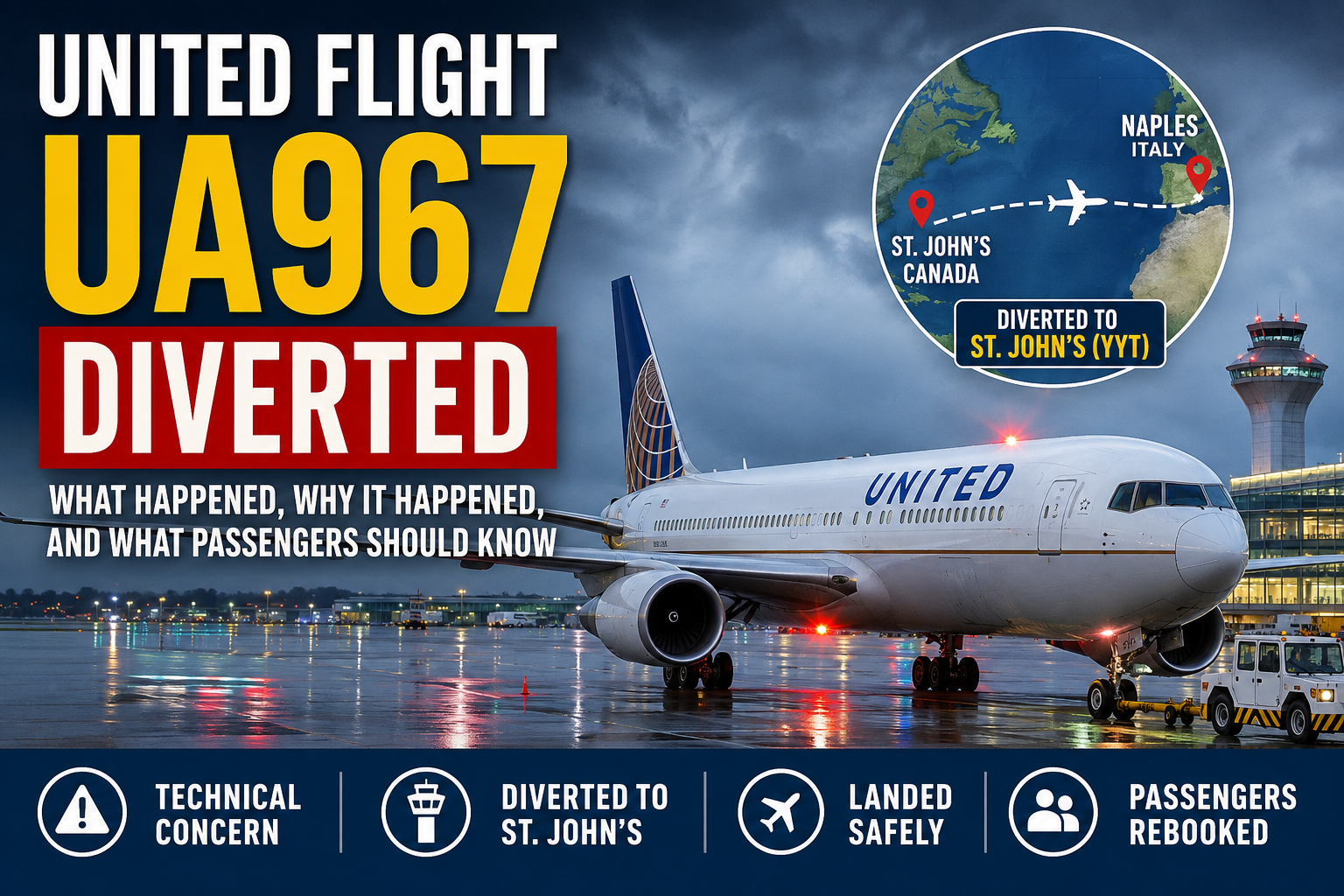
United Flight UA967 Diverted: What Happened?
United flight UA967 diverted during a transatlantic journey from Naples, Italy, to Newark Liberty International Airport, turning what was supposed to be a routine trip into a long and unexpected travel disruption.
The incident that attracted the most attention occurred on August 24, 2025, when United Airlines Flight UA967, operated by a Boeing 767-300ER, was diverted to St. John’s International Airport in Newfoundland, Canada after a technical concern developed during the Atlantic crossing. The aircraft landed safely, and passengers were later transported onward to Newark on another aircraft.
Flight-tracking records also show that UA967 has experienced other diversions or operational reroutings, including diversions to Boston and Detroit in July 2026. That makes it important to distinguish the widely reported 2025 safety-related diversion from later operational flight-history entries.
This article explains the major UA967 diversion, what caused the disruption, how the crew responded, what happened to passengers, and what travelers can learn from the incident.
What Is United Flight UA967?
United Airlines Flight UA967 is a regularly scheduled international service connecting Naples International Airport (NAP) in Italy with Newark Liberty International Airport (EWR) in New Jersey.
The route crosses the Atlantic Ocean and is normally operated by a Boeing 767 wide-body aircraft. Because it is a long-distance international flight, the aircraft must carry enough fuel, comply with weight and weather restrictions, and operate according to strict transatlantic procedures.
Flight-tracking records show UA967 continuing to operate on the Naples-Newark route in 2026, with Boeing 767 aircraft used on the service.
UA967 at a glance
| Flight detail | Information |
|---|---|
| Airline | United Airlines |
| Flight number | UA967 |
| Normal route | Naples (NAP) to Newark (EWR) |
| Aircraft type | Boeing 767-300ER |
| Major reported diversion | August 24, 2025 |
| Diversion airport | St. John’s International Airport (YYT) |
| Country of diversion | Canada |
| Reported issue | Technical concern / unusual burning odor |
| Outcome | Safe landing |
| Passenger impact | Significant delay and replacement aircraft |
Why Was United Flight UA967 Diverted?
The major 2025 diversion was associated with a technical issue detected during the flight.
Reports from the incident said the crew noticed a burning odor and a related technical indication while the aircraft was crossing the Atlantic. Because an unexplained smell or possible electrical/mechanical problem can potentially become more serious, the crew treated the situation cautiously.
Rather than continuing over the Atlantic toward Newark, the pilots decided that landing at a suitable airport was the safer option.
The decision was not an indication that the aircraft was necessarily in immediate danger. In commercial aviation, crews are trained to respond early when an abnormal indication appears, particularly when an aircraft is far from its destination and over an ocean.
Reports placed the aircraft about seven hours into its journey when it diverted toward St. John’s.
Where Did UA967 Land?
United flight UA967 diverted to St. John’s International Airport (YYT) in Newfoundland and Labrador, Canada.
According to flight-tracking reports, the Boeing 767 landed at St. John’s at approximately 8:25 p.m. local time on August 24, 2025, after spending roughly seven hours in flight.
St. John’s is an important airport for transatlantic aviation because of its geographic position in eastern Canada. Its location makes it a practical alternate for aircraft operating between Europe and North America.
That geographic advantage matters during an Atlantic crossing. When an aircraft experiences a technical concern over the ocean, pilots cannot simply choose any nearby airport. They must consider runway capability, weather, aircraft performance, emergency services, fuel, air traffic control, and the nature of the problem.
Why Would Pilots Divert Instead of Continuing?
Passengers sometimes wonder why a flight cannot simply continue if there is no visible fire or major emergency.
The answer comes down to risk management.
A technical problem may appear minor initially but could become more difficult to manage later. A crew therefore has to consider the potential consequences rather than waiting for a situation to become critical.
A diversion can be the most conservative decision when:
- A warning or abnormal indication appears.
- An unusual smell is detected.
- There is concern about electrical equipment.
- A mechanical system is not behaving normally.
- Weather makes continuing unsafe.
- A passenger or crew member needs urgent medical treatment.
- The aircraft needs inspection before continuing.
In the case of UA967, reports indicated that the crew chose to land after detecting a technical concern. The aircraft reached the airport safely.
Was There a Fire on United Flight UA967?
One of the biggest questions surrounding the incident was whether the burning odor meant that an actual fire had occurred.
Available reports do not indicate that the aircraft landed at St. John’s with a confirmed major fire. Instead, the burning smell and technical indication prompted the precautionary diversion.
That distinction is important.
Aviation crews are not expected to wait until smoke or flames appear before taking action. An unexplained burning smell can be enough to trigger checklists, communication with air traffic control, coordination with airline operations, and consideration of a diversion.
This is one reason aviation incidents that look dramatic to passengers can end with a completely controlled landing.
How Did the Crew Respond?
The crew’s response demonstrates an important principle of airline operations: early action is generally preferable to waiting for a problem to escalate.
Once the abnormal condition was identified, the pilots had several responsibilities. They had to assess the aircraft’s condition, communicate with air traffic control, determine an appropriate alternate airport, manage fuel considerations, and keep the aircraft under control.
The flight’s diversion to St. John’s gave the aircraft access to airport infrastructure and maintenance resources rather than continuing for several more hours toward Newark.
Reports indicate the aircraft landed safely without the type of catastrophic outcome that passengers may fear when they hear the word “emergency.”
What Happened to the Passengers?
The diversion created a substantial delay for passengers traveling from Naples to Newark.
After the aircraft was taken out of service for technical inspection, United arranged another Boeing 767 to continue the journey.
AirLive reported that a replacement aircraft, identified as another Boeing 767, continued toward Newark and that passengers arrived more than 10 hours later than originally expected.
For passengers, the biggest practical consequences of a diversion are usually:
- A longer journey.
- Waiting inside the diversion airport.
- Rebooking or aircraft replacement.
- Delayed baggage handling.
- Missed onward connections.
- Changes to hotel or ground transportation plans.
Although these disruptions are frustrating, the alternative—continuing a long overwater flight with an unresolved technical concern—could present a much greater risk.
Did UA967 Have Other Diversions?
Yes. This is an important point for anyone searching for united flight ua967 diverted because flight-history databases show more than one diversion associated with the flight number.
For example, flight-tracking data records UA967 as diverting to Boston (BOS) on July 18, 2026. The same records show the aircraft subsequently listed for the Boston-Newark segment.
Another flight-history entry shows UA967 diverting to Detroit (DTW) on July 28, 2026, rather than completing its normal Naples-to-Newark routing.
A separate flight-tracking service lists the July 28 aircraft as reaching the United States at Pittsburgh, illustrating why flight-tracking databases can sometimes display different airport information depending on how the operation and subsequent positioning flights are recorded.
These later entries should not automatically be treated as evidence of the same technical incident that occurred in August 2025.
Why Do Flight Diversions Happen?
Flight diversions are not always caused by aircraft failures.
Airlines can divert flights for a wide range of reasons, including:
Technical problems
Mechanical or electrical warnings can require an aircraft to land for inspection.
Medical emergencies
A serious passenger illness can lead pilots to select the nearest suitable airport.
Severe weather
Thunderstorms, snow, strong winds, hurricanes, or poor visibility can make the planned destination unsuitable.
Airport problems
Runway closures, equipment failures, security incidents, or other airport disruptions can force aircraft to change destinations.
Operational considerations
Fuel, aircraft performance, air traffic restrictions, or other operational factors can occasionally result in an unplanned landing.
Therefore, seeing the word “diverted” in a flight tracker does not automatically mean an aircraft was in serious danger.
What Does a Diversion Mean for Flight Safety?
For passengers, a diversion can feel frightening because the aircraft suddenly stops following its expected route.
From an aviation perspective, however, a diversion is often a safety tool.
The purpose is to move the aircraft into a situation where crews have better access to runways, emergency personnel, maintenance teams, fuel, medical support, and passenger services.
The UA967 incident is a good example of this principle. Instead of continuing across the Atlantic after a technical concern appeared, the crew selected a suitable alternate airport and landed safely.
What Should Passengers Do If Their Flight Is Diverted?
Travelers cannot control where an aircraft diverts, but they can make the recovery process easier.
Keep your boarding pass
Keep your original boarding pass and flight information because you may need it for rebooking, baggage claims, or travel documentation.
Follow crew instructions
The cabin crew will receive operational information from the cockpit and airline. Their instructions should take priority over rumors circulating among passengers.
Check the airline app
Once the aircraft is on the ground, airline applications and airport information screens may provide updated rebooking details.
Don’t assume your connecting flight is protected
If you have a separate ticket for a connecting journey, contact the relevant airline as soon as practical.
Keep important items in your carry-on
Medication, identification, chargers, travel documents, and valuables should normally remain with you rather than in checked luggage.
Is United Flight UA967 Still Operating?
Yes. Flight-history information shows UA967 continuing to operate between Naples and Newark during 2026, although individual flights have experienced cancellations, delays, and diversions.
For travelers checking the flight today, the safest approach is to use United’s official flight-status information and the airport’s live departure information rather than relying on an old article about a previous diversion.
This is particularly important because flight numbers are reused. A search for “UA967 diverted” may return information about the 2025 St. John’s incident, a July 2026 diversion, or another operational event.
Frequently Asked Questions
What happened to United Flight UA967?
The most widely reported UA967 diversion occurred on August 24, 2025. The Naples-to-Newark Boeing 767 was diverted to St. John’s, Canada, after the crew encountered a technical concern during the Atlantic crossing.
Why was United Flight UA967 diverted?
Reports linked the 2025 diversion to a technical issue and an unusual burning odor detected during the flight. The crew chose to divert as a precaution rather than continue the transatlantic journey with the issue unresolved.
Where did UA967 land?
The 2025 incident ended with the aircraft landing at St. John’s International Airport in Newfoundland, Canada.
Was anyone injured?
Available reports on the 2025 diversion indicate that the aircraft landed safely and no passenger injuries were reported.
Did UA967 continue to Newark?
Passengers were transported onward using a replacement aircraft after the original aircraft was taken out of service for technical attention. Reports said the journey ultimately reached Newark more than 10 hours behind schedule.
Is UA967 still flying?
Yes. Flight-tracking records show UA967 continuing to operate on the Naples-Newark route during 2026, although individual flights can be delayed, canceled, or diverted.
Final Takeaway
The story behind united flight ua967 diverted is ultimately a story about how airlines respond when something unexpected happens during a long-haul flight.
The major August 2025 incident involved a Boeing 767 traveling from Naples to Newark. After a technical concern developed during the Atlantic crossing, the crew diverted to St. John’s, Newfoundland, where the aircraft landed safely. A replacement aircraft later continued the journey, although passengers experienced a lengthy delay.
Flight-history records also show that UA967 has had other operational diversions in 2026, which means travelers should always check the date of the information they find online.
For passengers, the key lesson is simple: a diversion does not automatically mean a flight was on the verge of disaster. In many cases, it means the pilots identified a potential problem early and chose the safest available option.
That is exactly what aviation safety procedures are designed to accomplish—turn an unexpected problem into a controlled landing rather than allowing it to become a larger emergency.
