


Test.com Pricing Enterprise Plans: Costs, Features, and Complete Guide
Choosing an online testing platform for a large organization requires more than comparing subscription prices. Businesses, certification providers, training organizations, and educational institutions must consider annual software fees, hosting expenses, implementation costs, testing volume, and the features needed to manage assessments efficiently.
If you are researching test.com pricing enterprise plans, understanding the pricing structure can help you prepare a realistic budget and determine whether an enterprise testing solution meets your organization’s requirements.
Test.com is associated with Gauge Online, a platform designed for professional testing and certification programs. Its pricing model is intended to accommodate organizations with different assessment volumes and operational needs. Enterprise customers should pay particular attention to the published starting prices, additional fees, and volume-based pricing arrangements before making a purchasing decision.
This guide explains the available pricing information, the main cost components, potential enterprise features, and the questions buyers should ask before requesting a quotation.
What Is Test.com?
Test.com, Inc. is associated with Gauge Online, a platform used to support online testing, professional assessments, and certification programs.
Unlike a basic quiz application, an enterprise assessment platform can help organizations manage a wider testing workflow. Depending on the selected services and configuration, this may include creating examinations, organizing question banks, delivering assessments, evaluating results, and managing certification activities.
Such systems can be useful for professional associations, training providers, employers, compliance teams, and organizations that need to evaluate large numbers of candidates.
The intended use matters when comparing prices. A small business conducting occasional internal quizzes may have very different requirements from a certification organization administering thousands of examinations every year.
Before evaluating pricing, identify the purpose of the platform, the expected number of tests, the number of administrators, and any technical integrations your organization requires.
Test.com Pricing Enterprise Plans: An Overview
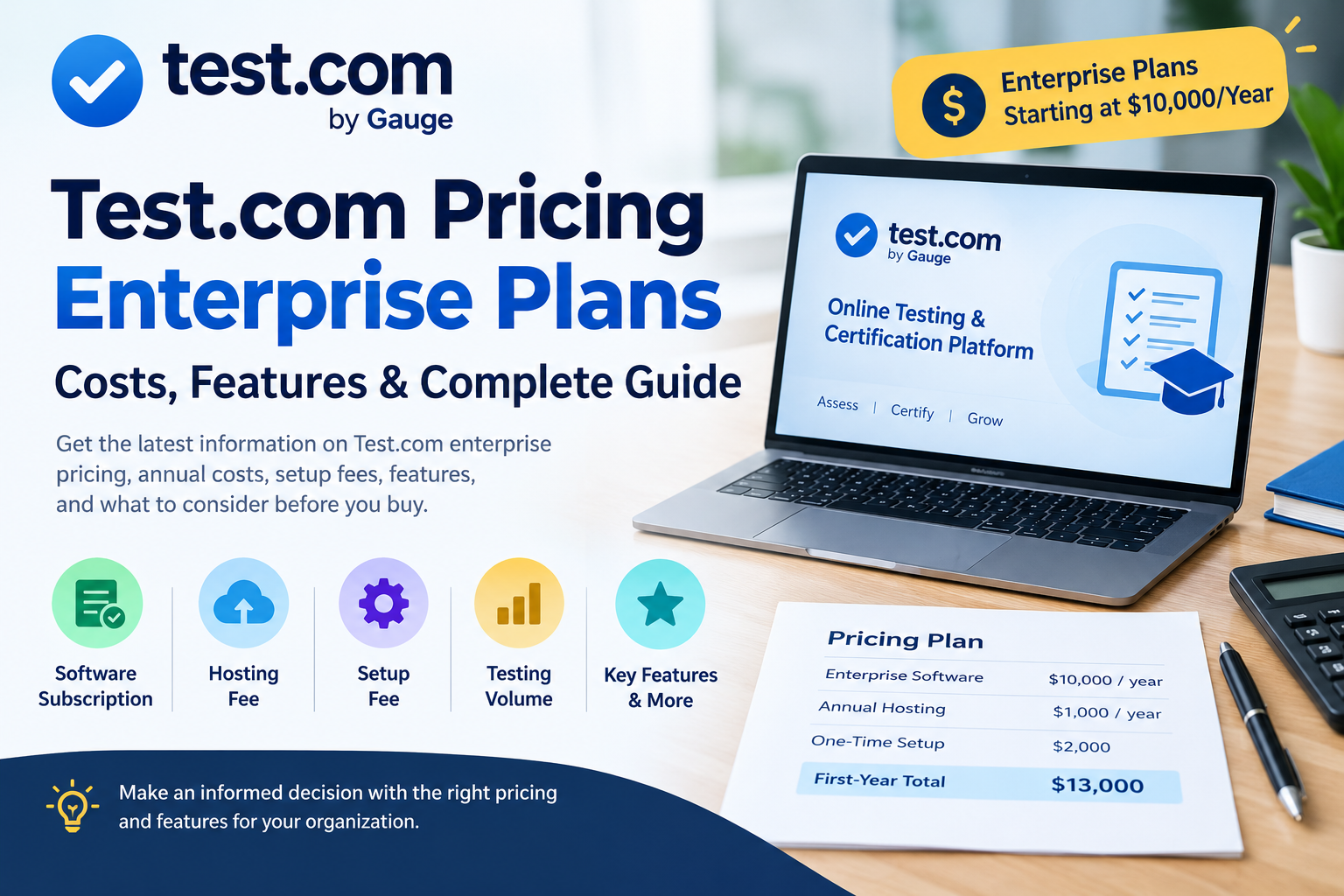
Gauge’s published pricing information has listed Enterprise software starting at $10,000 per year. The published starting figures also include annual hosting charges and a one-time setup fee.
The following table summarizes the reported starting amounts. These figures should be checked against the provider’s current quotation before purchase because enterprise pricing and commercial terms can change.
| Pricing component | Published starting amount |
|---|---|
| Enterprise software | $10,000 per year |
| Annual hosting | $1,000 per year |
| One-time setup | $2,000 |
| Calculated first-year starting total | $13,000 |
| Software and hosting before other charges in subsequent years | $11,000 per year |
The first-year estimate is calculated by adding the software fee, hosting charge, and setup fee. It is a budgeting baseline rather than a guaranteed price for every customer.
Actual costs may depend on testing volume, required modules, implementation arrangements, and other terms included in the final agreement.
How Much Does the Enterprise Plan Cost?
Understanding the individual fees is more useful than looking at the software price alone.
1. Annual Software Subscription
The software subscription covers access to the platform under the selected commercial agreement. The published Enterprise starting figure is $10,000 annually.
Organizations should confirm exactly which functions are included in their quotation. They should also ask whether additional capabilities, specialized services, or integrations require separate charges.
The subscription price alone does not necessarily represent the full cost of operating a testing program.
2. Annual Hosting Fee
The published Enterprise pricing information lists hosting at $1,000 per year.
Hosting is an important part of the overall budget because it is a recurring expense rather than a one-time implementation payment.
When reviewing a quotation, confirm what the hosting charge covers, whether it changes with usage, and whether any additional infrastructure or service fees may apply.
3. One-Time Setup Fee
The published Enterprise starting figures include a one-time setup charge of $2,000.
Implementation may involve configuring the platform, preparing an assessment workflow, or coordinating the initial deployment. The exact work included should be confirmed directly with the provider rather than assumed from the fee alone.
Ask whether data migration, administrator training, custom configuration, and integration work are included or billed separately.
4. First-Year Budget
Using the published starting amounts, the basic first-year calculation is:
$10,000 software + $1,000 hosting + $2,000 setup = $13,000.
The recurring software and hosting components total $11,000 annually before any other applicable charges, based on those same starting figures.
This calculation gives procurement teams a useful starting point for financial planning. However, it should not be treated as a final contractual price.
How Testing Volume Affects Enterprise Pricing
Testing volume is one of the most important considerations for organizations comparing enterprise assessment platforms.
Gauge’s published information positions Enterprise for larger programs conducting more than 10,000 tests annually. Its reported volume-pricing structure starts at $3 per test and decreases as volume increases, with the company indicating that its highest-volume customers may pay well below $1 per test.
These figures describe a published pricing approach, not a guaranteed rate for every customer.
For example, an organization expecting 12,000 assessments per year may have different requirements from a provider administering 100,000 assessments. The two organizations should evaluate their expected volume, service needs, and quoted costs separately.
When reviewing a proposal, clarify whether test-volume charges are additional to the annual subscription or included in the quoted package. Also ask how unused capacity, additional tests, and unexpected increases in demand are handled.
A clear understanding of the pricing model can help prevent budget surprises after implementation.
What Features Should Buyers Evaluate?
Price is only one part of an enterprise software decision. Buyers should examine whether the platform provides the capabilities required for their assessment program.
Exam Creation and Management
An assessment platform may provide tools for preparing questions, organizing exams, and configuring examination settings. Buyers should confirm which question formats and assessment workflows are supported by their selected plan.
Reporting and Analytics
Reporting can help administrators review candidate performance, identify patterns, and monitor assessment outcomes. Organizations should determine whether the available reports meet their operational and compliance requirements.
Certification Management
For professional associations and training providers, certification workflows can be particularly important. Ask how the platform supports issuing credentials, tracking results, and managing relevant certification activities.
Proctoring Options
Some examination programs require supervision to protect assessment integrity. Buyers should confirm which remote or in-person proctoring options are available and whether they carry additional charges.
Integrations and API Access
Organizations may need to connect an assessment platform with learning management systems, internal databases, or other business applications.
Before signing an agreement, confirm API availability, integration limits, technical documentation, and whether custom development is included in the proposed price.
Support and Implementation
Enterprise customers should also review onboarding arrangements, technical support, service commitments, and escalation procedures. These details can be as important as the subscription price when a testing program operates at scale.
Feature availability and contract terms should always be verified against the current plan documentation.
Enterprise vs. Professional: Which Is More Suitable?
A Professional plan may be appropriate for an organization that operates a growing testing program with moderate requirements. Enterprise is generally intended for larger programs that need greater scale or a more extensive commercial arrangement.
The published starting figures for Gauge’s Professional plan have been $750 per year for software, $250 for annual hosting, and a $500 one-time setup fee. Together, these amounts produce a calculated first-year starting total of $1,500.
By comparison, the published Enterprise starting figures produce a calculated first-year total of $13,000.
These figures are not directly comparable without considering differences in usage limits, included features, and volume charges.
Before choosing a plan, estimate annual examination volume, identify essential features, and request a written breakdown of all recurring and one-time expenses. A lower headline subscription price may not produce the lowest total cost if the plan does not suit your requirements.
Questions to Ask Before Purchasing
A structured procurement process can help your organization choose a suitable testing platform.
- What is the complete first-year cost, including software, hosting, setup, and usage charges?
- How is the price calculated when annual test volume increases?
- Which exam creation, reporting, certification, and proctoring features are included?
- Are API integrations, webhooks, or single sign-on available under the proposed plan?
- Are implementation, migration, and administrator training included?
- What support arrangements and service-level commitments are provided?
- How are renewals, price increases, and contract termination handled?
- Are there additional charges for storage, custom development, or specialized services?
Requesting clear written answers will make it easier to compare competing vendors and understand the financial commitment.
How to Evaluate the Total Cost of Ownership
The total cost of ownership includes more than the initial subscription. Organizations should consider recurring fees, usage charges, internal administration time, training, integrations, and any additional services needed to operate the platform.
A practical evaluation begins with an estimate of annual test volume. Next, identify the features required for the program and obtain a detailed quotation that separates fixed fees from variable expenses.
It is also useful to calculate the effective cost per completed assessment. Divide the relevant annual platform expenses by the number of assessments actually delivered, taking care to include the appropriate fees and avoid comparing different pricing models as though they were identical.
Finally, consider operational reliability, data management requirements, user experience, and the time required to administer examinations. The lowest-priced solution is not automatically the most cost-effective choice.
Conclusion
Researching test.com pricing enterprise plans is an important step for organizations that need a professional testing and certification platform. The published Gauge Enterprise starting figures include $10,000 annually for software, $1,000 annually for hosting, and a one-time setup fee of $2,000.
Together, those amounts produce a calculated first-year starting cost of approximately $13,000, before other applicable charges. The software and hosting components total $11,000 annually using the same published starting figures.
However, enterprise pricing can depend on testing volume, feature requirements, and the final commercial agreement. Organizations should therefore verify current prices directly with the provider and request a complete quotation before committing.
The best decision comes from comparing total costs, essential capabilities, projected usage, and support requirements rather than relying on a single advertised price.
Frequently Asked Questions (FAQs)
1. How much does Test.com Enterprise cost?
The published starting figures for Gauge Enterprise have been $10,000 per year for software, $1,000 per year for hosting, and a one-time setup fee of $2,000. The calculated first-year starting total is approximately $13,000. Confirm current pricing with the provider.
2. Is Test.com associated with Gauge Online?
Yes. Test.com, Inc. is associated with Gauge Online, a platform for online testing and certification programs.
3. Is the Enterprise plan suitable for small businesses?
It depends on the organization’s testing volume and requirements. Businesses running occasional assessments should compare the available lower-tier options before committing to an enterprise-level arrangement.
4. Does enterprise pricing depend on testing volume?
Yes. Gauge’s published information describes volume-based pricing for larger testing programs. Buyers should confirm how their expected assessment volume affects the final quotation.
5. Are hosting fees included in the Enterprise subscription?
The published starting figures list hosting separately at $1,000 per year. Confirm the current quotation to understand which charges are included in the proposed agreement.
6. Is the setup fee recurring?
The published starting figure describes a $2,000 one-time setup fee. Buyers should verify whether additional implementation or customization services may incur separate costs.
7. Can organizations integrate the platform with other software?
Integration requirements should be discussed with the provider. Ask about API access, webhooks, single sign-on, supported systems, and any additional development charges.
8. What should buyers compare before selecting an enterprise testing platform?
Compare total annual costs, testing limits, assessment features, reporting, certification management, proctoring, integrations, security requirements, and support arrangements.
9. Is the published Enterprise starting price guaranteed?
No. A published starting price is not necessarily the final price offered to every customer. The final quotation may reflect usage, required features, services, and negotiated contract terms.
10. How can an organization get an accurate Enterprise quote?
Estimate the number of assessments expected each year, list the required features and integrations, and contact the provider for a written quotation that clearly separates setup costs, recurring fees, and volume-related charges.
