


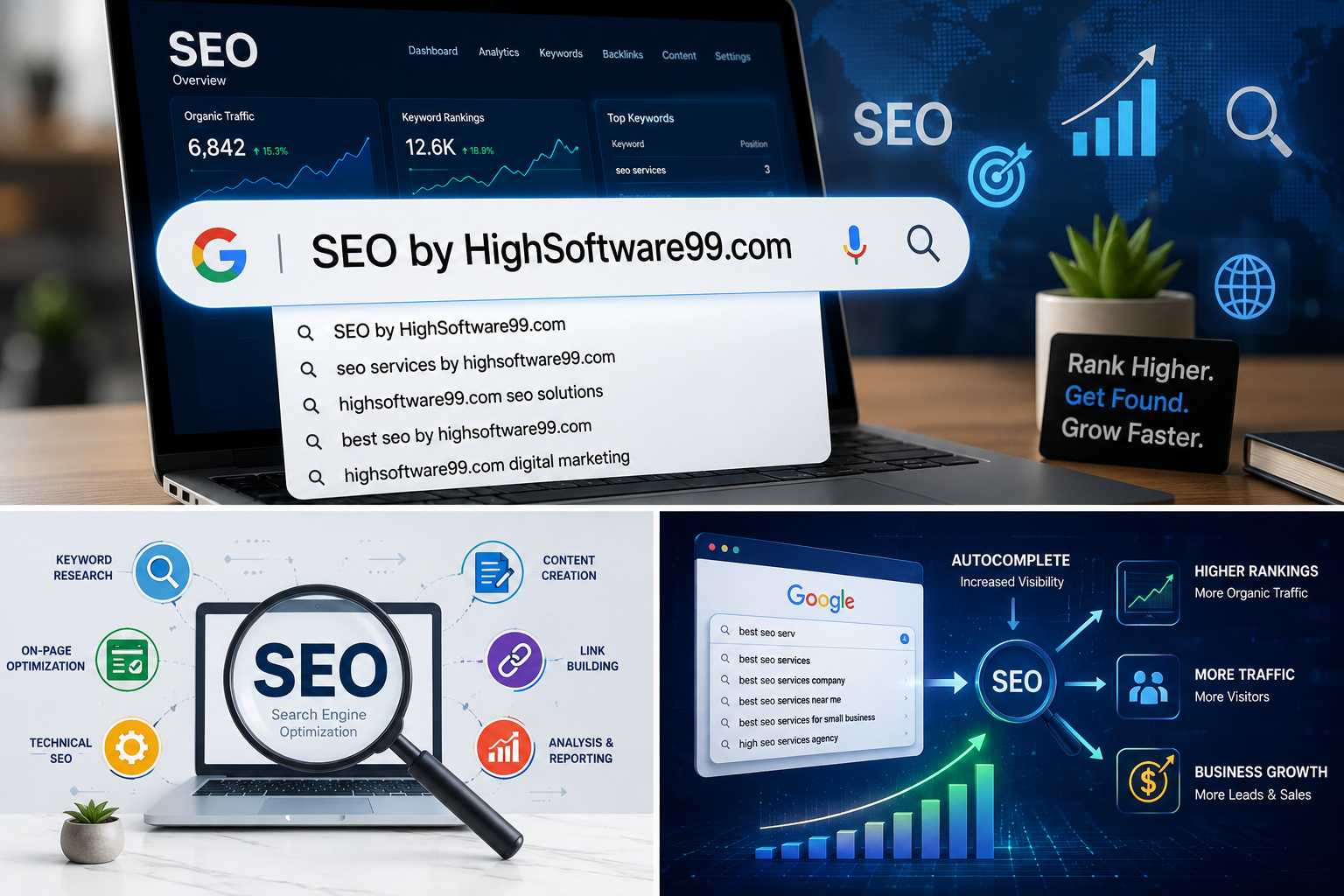
Search engine optimization has become one of the most important parts of running a website. Whether the goal is to attract customers, build a brand, generate leads, or increase organic traffic, appearing in search results can make a major difference. At the same time, SEO has become much more complicated than simply adding keywords to an article.
This is where SEO by HighSoftware99.com enters the conversation. The name has recently appeared across search results and SEO-related websites, particularly in connection with Google Autocomplete, technical optimization, content structure, and search visibility.
HighSoftware99.com’s own website currently promotes services focused specifically on Google Auto Complete, also referred to as ATC services. It claims that selected keywords can be boosted into autocomplete suggestions within a short period, including a stated timeframe of roughly 3 to 12 hours.
That claim makes the topic interesting, but it also creates an important question: What exactly is SEO by HighSoftware99.com, and how is it different from traditional SEO?
The answer requires looking beyond the marketing language and understanding what search visibility actually means.
What Is SEO by HighSoftware99.com?
SEO by HighSoftware99.com generally refers to a search visibility service associated with HighSoftware99.com. The service is particularly connected with Google Autocomplete or Autosuggest visibility.
Traditional SEO usually focuses on improving a website’s ability to rank in Google’s organic search results. That involves things such as useful content, technical SEO, internal linking, website structure, page experience, keyword targeting, and authority.
Google Autocomplete is different.
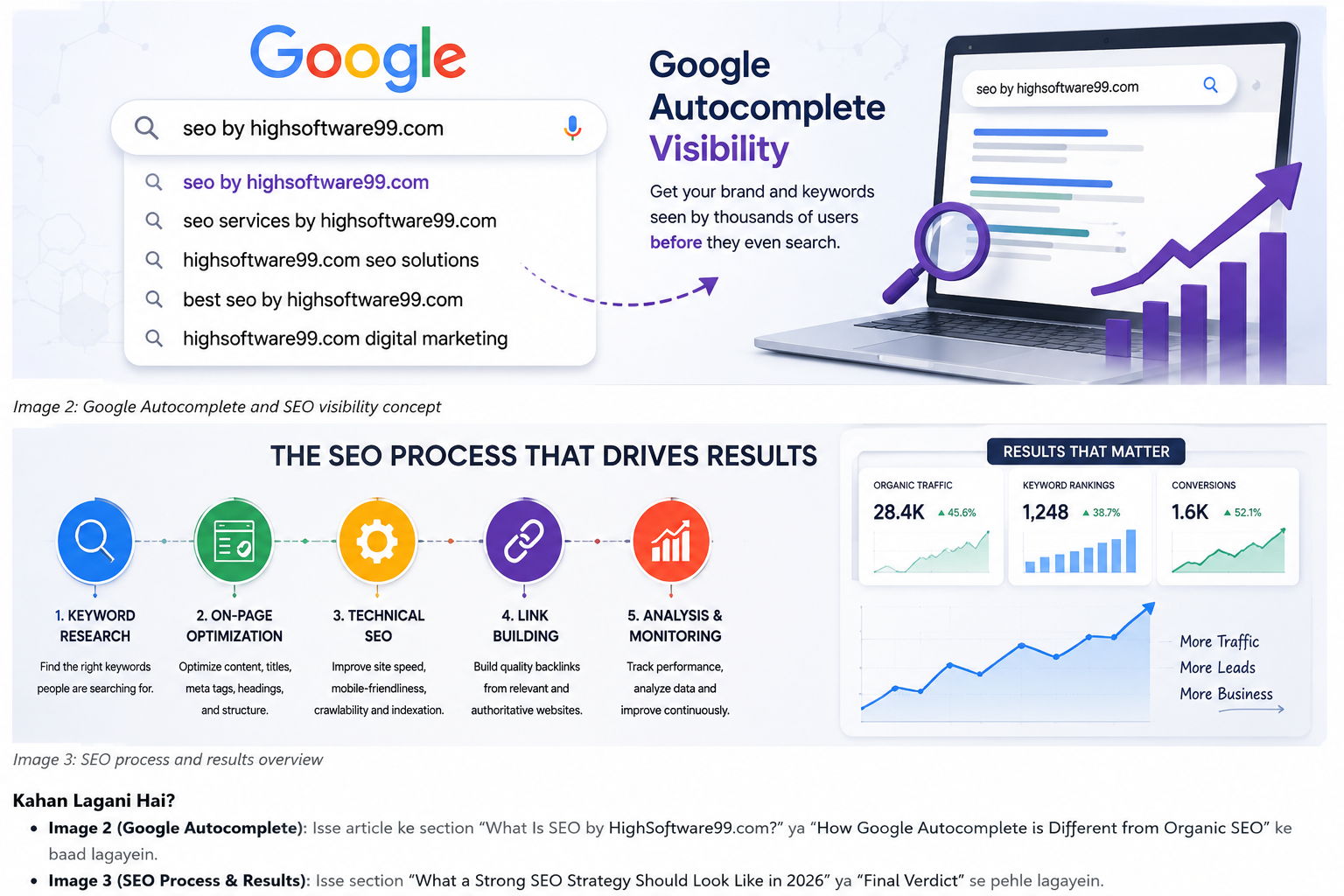
Autocomplete appears while a person is typing a search query. Instead of waiting for the user to press Enter and see a results page, Google displays possible search phrases underneath the search box.
SEO by HighSoftware99.com specifically markets its service around this earlier stage of the search journey. Its website presents examples involving searches such as “seo” in the United States and “seo service” in India.
This distinction is important because appearing in autocomplete is not the same thing as ranking number one in Google.
A business can potentially have a phrase appear as a suggestion without having its website rank highly for that phrase. Conversely, a website can rank strongly for a keyword without that keyword appearing as an autocomplete suggestion.
How Google Autocomplete Is Different From Organic SEO
For someone unfamiliar with search marketing, autocomplete and organic rankings can look like the same thing. They are not.
Organic SEO starts when a person submits a search. Google then evaluates relevant pages and determines which results should appear.
Autocomplete happens before that.
For example, someone might begin typing:
best seo…
Google may offer several possible completions before the person finishes the query.
The purpose is to help users search faster. Google says its autocomplete systems use signals such as real searches, language, location, and trending interests when generating predictions.
This makes autocomplete a search-behavior feature rather than a conventional ranking position.
That is why anyone considering SEO by HighSoftware99.com should first establish exactly what outcome they are purchasing. Is the objective autocomplete visibility, organic rankings, traffic, leads, brand awareness, or a combination of these?
Those are different goals and should be measured differently.
What HighSoftware99.com Promotes
The official HighSoftware99.com website presents itself primarily around Google Auto Complete and ATC services. Its headline emphasizes improving keyword visibility through autocomplete and highlights a short time window for seeing changes.
The website also presents a broader marketing-oriented approach, including strategy, creative execution, and portfolio examples.
A separate site associated with the HighSoftware99 name describes technical SEO, local SEO, semantic HTML, crawlability, and structured content as parts of its optimization methodology.
This creates two related but distinct areas:
- Traditional SEO: improving a website’s ability to be discovered, understood, indexed, and ranked.
- Autocomplete visibility: attempting to influence which phrases users see while typing searches.
Understanding this difference is probably the most useful starting point for anyone researching the service.
Why Autocomplete Visibility Can Matter
Autocomplete may look like a small part of Google, but it can influence how people formulate searches.
Imagine a customer starts typing the name of a product, company, or service. If a relevant phrase appears as a suggestion, the user may choose it rather than manually completing the query.
That can affect search behavior.
For brands, appearing around relevant searches may also contribute to recognition. A phrase repeatedly encountered during the search process can become more familiar to users.
However, this should not be confused with guaranteed traffic.
An autocomplete suggestion does not automatically send visitors to a website. The user still needs to select the suggestion, submit the search, and then click an actual result.
For that reason, autocomplete should be viewed as a visibility or discovery mechanism, not a replacement for conventional SEO.
The Role of Technical SEO
Technical SEO remains important regardless of whether a company uses an autocomplete-focused service.
A technically weak website can struggle even when its content is excellent. Search engines need to crawl pages, understand their structure, process important resources, and identify which content deserves to be indexed.
Common technical SEO areas include:
Crawlability
Search engines need access to important pages. Problems with robots.txt, redirects, broken links, or website architecture can interfere with crawling.
Indexing
Getting a page crawled does not automatically mean it will perform well in search. Website owners should understand which pages are indexed and whether important content is actually available to search engines.
Page Performance
Slow pages can create a poor user experience. Improving server response times, image delivery, JavaScript execution, and other performance factors can make a site more efficient.
Mobile Experience
Most modern websites need to work properly on phones and tablets. A page that looks good on desktop but is difficult to use on mobile can lose visitors.
Structured Content
Clear headings, descriptive titles, logical sections, useful links, and understandable page organization help both readers and search engines interpret a page.
Some HighSoftware99-related materials specifically emphasize technical performance and semantic HTML as part of their optimization approach.
Content Still Matters
No SEO strategy can compensate indefinitely for poor content.
A website might have excellent technical performance, but if its articles do not answer the user’s questions, visitors have little reason to stay.
Good SEO content should begin with search intent.
Before writing an article, ask:
- What is the person actually looking for?
- Are they researching a topic?
- Are they comparing services?
- Are they ready to purchase?
- Do they need instructions?
- Are they trying to find a particular company or website?
The answer determines what type of page should be created.
For example, someone searching “what is technical SEO” needs an educational explanation. Someone searching “technical SEO agency” may be evaluating service providers.
Treating both queries with the same article would miss the user’s intent.
Semantic SEO and Topic Relationships
Modern search engines are increasingly capable of understanding relationships between concepts rather than relying only on exact keyword matches.
That makes semantic SEO valuable.
Instead of writing an article that repeats “SEO by HighSoftware99.com” in every paragraph, a better article can naturally discuss related concepts such as:
- Google Autocomplete
- search visibility
- organic rankings
- technical SEO
- keyword research
- search intent
- content quality
- local SEO
- internal linking
- website performance
- Google Search Console
This creates a more complete topic rather than a page that looks like it was written solely to manipulate a keyword.
HighSoftware99-related materials also describe semantic HTML and structured content architecture as important parts of their methodology.
Is SEO by HighSoftware99.com the Same as Normal SEO?
No.
This is probably the simplest way to understand it.
Traditional SEO is concerned with improving a website’s performance in organic search results. That is a broad discipline covering content, technical factors, links, site architecture, user experience, and search intent.
The SEO by HighSoftware99.com offering highlighted on its official website is more specifically associated with Google Autocomplete/ATC visibility.
There are also other HighSoftware99-related pages that describe broader technical and local SEO services.
Therefore, the exact service should be confirmed before purchasing. A potential customer should not assume that an autocomplete package automatically includes a full SEO campaign.
What Businesses Should Ask Before Paying for SEO
SEO services can vary dramatically, so asking questions before signing up is sensible.
1. What exactly am I buying?
Ask for a written description of the service.
If the product is autocomplete visibility, make sure that is clearly stated. If traditional SEO is included, ask what specific work will be performed.
2. How will success be measured?
A professional campaign should have measurable objectives.
Depending on the service, useful metrics might include:
- Organic impressions
- Organic clicks
- Keyword rankings
- Qualified traffic
- Leads
- Sales
- Conversion rate
- Technical SEO improvements
For autocomplete-related work, the measurement methodology should be explained separately.
3. What happens after the campaign ends?
This is an especially important question when a service promises rapid visibility.
Some SEO improvements can continue producing value after the work is completed. Others may depend on ongoing activity.
Understanding that difference helps businesses set realistic expectations.
4. Can results be verified independently?
Businesses should be able to check important performance information through their own analytics and search platforms rather than depending exclusively on screenshots supplied by a vendor.
Google Search Console and website analytics can provide useful independent evidence of organic search performance.
The Biggest Misunderstanding About “Instant SEO”
The phrase “instant SEO” can create unrealistic expectations.
Some SEO changes really can have quick effects.
For example, if a website accidentally blocks search engines from crawling an important page, fixing the problem can produce a meaningful improvement once the page is recrawled.
Similarly, correcting a broken canonical tag, fixing an indexing problem, or resolving a major technical error can sometimes lead to relatively quick changes.
But that is different from building long-term organic authority.
A new website competing against established businesses for valuable keywords should not expect a few technical changes to guarantee first-page rankings overnight.
Search visibility is usually cumulative. Content, authority, relevance, technical quality, competition, and user demand all play roles.
Potential Benefits of an Autocomplete-Focused Strategy
There are some logical reasons a business might be interested in autocomplete visibility.
First, it can create additional exposure around selected phrases.
Second, it may help a brand become more recognizable during the search process.
Third, it targets users before they reach the traditional search results page.
Fourth, it can be considered alongside a larger search marketing strategy.
But the limitations are equally important.
Autocomplete visibility should not be treated as proof that a website has earned a high organic ranking. It also should not be used as the only SEO KPI.
The strongest approach is to connect visibility efforts to actual business outcomes.
SEO by HighSoftware99.com: Who Might Be Interested?
The service may attract several types of users.
Small businesses may be interested because they often want faster visibility without committing to a large agency.
Digital marketers may want to understand autocomplete-focused search strategies.
Website owners researching unusual SEO methods may encounter the term while investigating search visibility.
SEO professionals may be interested because autocomplete represents a different layer of search behavior from traditional rankings.
For all of these groups, the same advice applies: understand exactly what is being offered and measure the result independently.
What a Strong SEO Strategy Should Look Like in 2026
A modern SEO campaign should not depend on one trick.
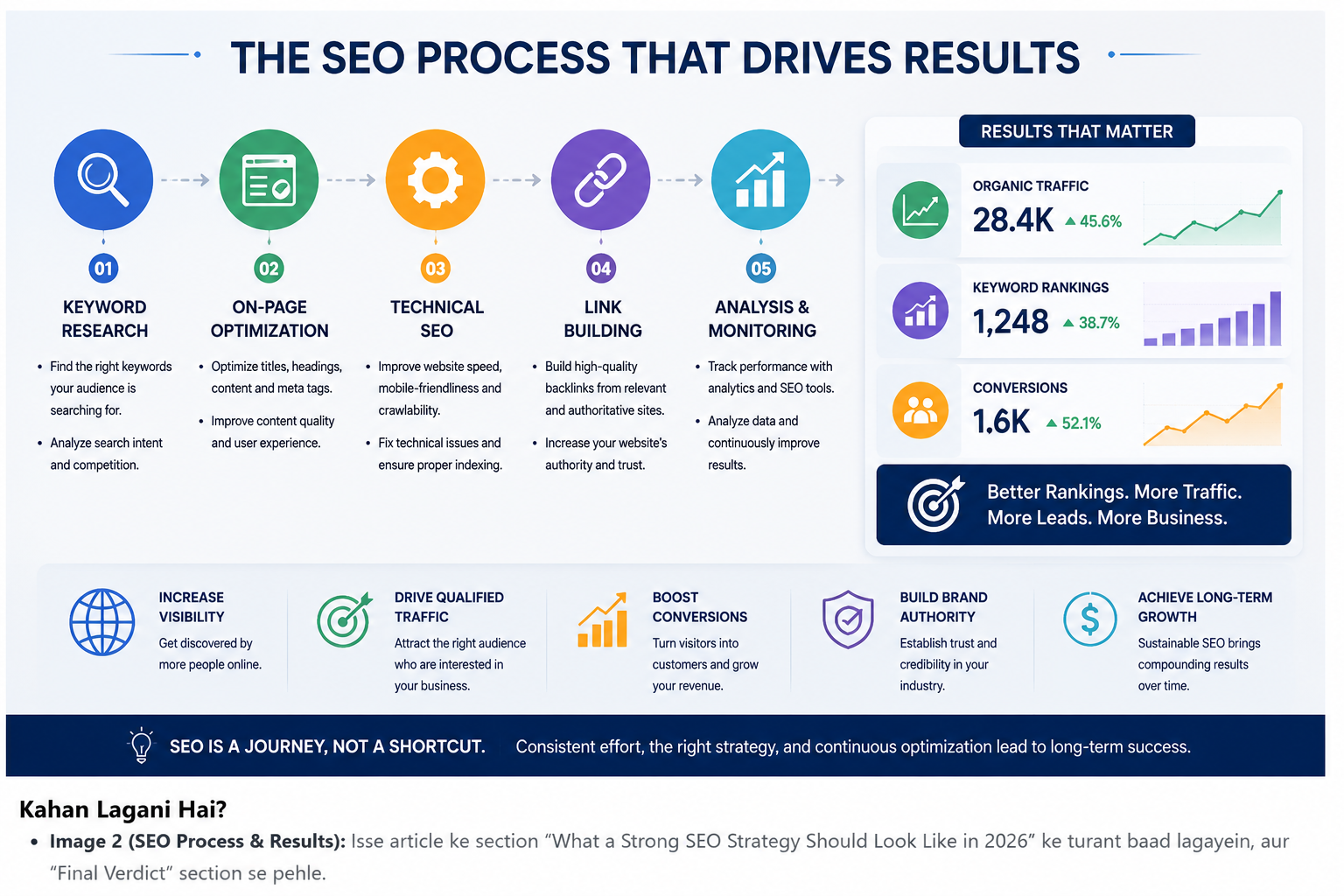
Instead, it should combine several areas:
- Search intent research — understand what users actually want.
- Useful content — provide a genuinely satisfying answer.
- Technical SEO — make the site accessible and efficient.
- Internal linking — connect related pages logically.
- Authority building — earn relevant mentions and links where appropriate.
- Local optimization — important for businesses serving specific locations.
- Performance monitoring — track rankings, traffic, conversions, and technical health.
- Content updates — improve important pages as information changes.
Autocomplete visibility, if used, should sit alongside these activities rather than replace them.
Final Verdict
SEO by HighSoftware99.com is an interesting search marketing concept because it focuses attention on an area many website owners overlook: Google Autocomplete.
The official HighSoftware99.com site specifically promotes Google Auto Complete/ATC services and claims rapid keyword visibility in autocomplete. Other HighSoftware99-related material describes technical SEO, local SEO, semantic structure, and performance optimization.
The most important thing to remember is that Google Autocomplete visibility and organic Google rankings are not the same thing.
If you are considering the service, do not judge it only by how quickly a phrase appears in a search suggestion. Ask what is being changed, how the result is measured, whether the effect produces meaningful traffic, and how the strategy fits into your wider SEO campaign.
For long-term growth, the fundamentals still matter: useful content, strong technical foundations, clear site architecture, relevant keywords, good user experience, and trustworthy authority.
In other words, an autocomplete-focused service may be one tool in a broader search strategy, but it should not be mistaken for the entire SEO process.
A website that wants sustainable organic traffic needs more than visibility at the search box. It needs pages that deserve to be found, content that deserves to be read, and a site that gives both users and search engines a clear reason to trust it.
