


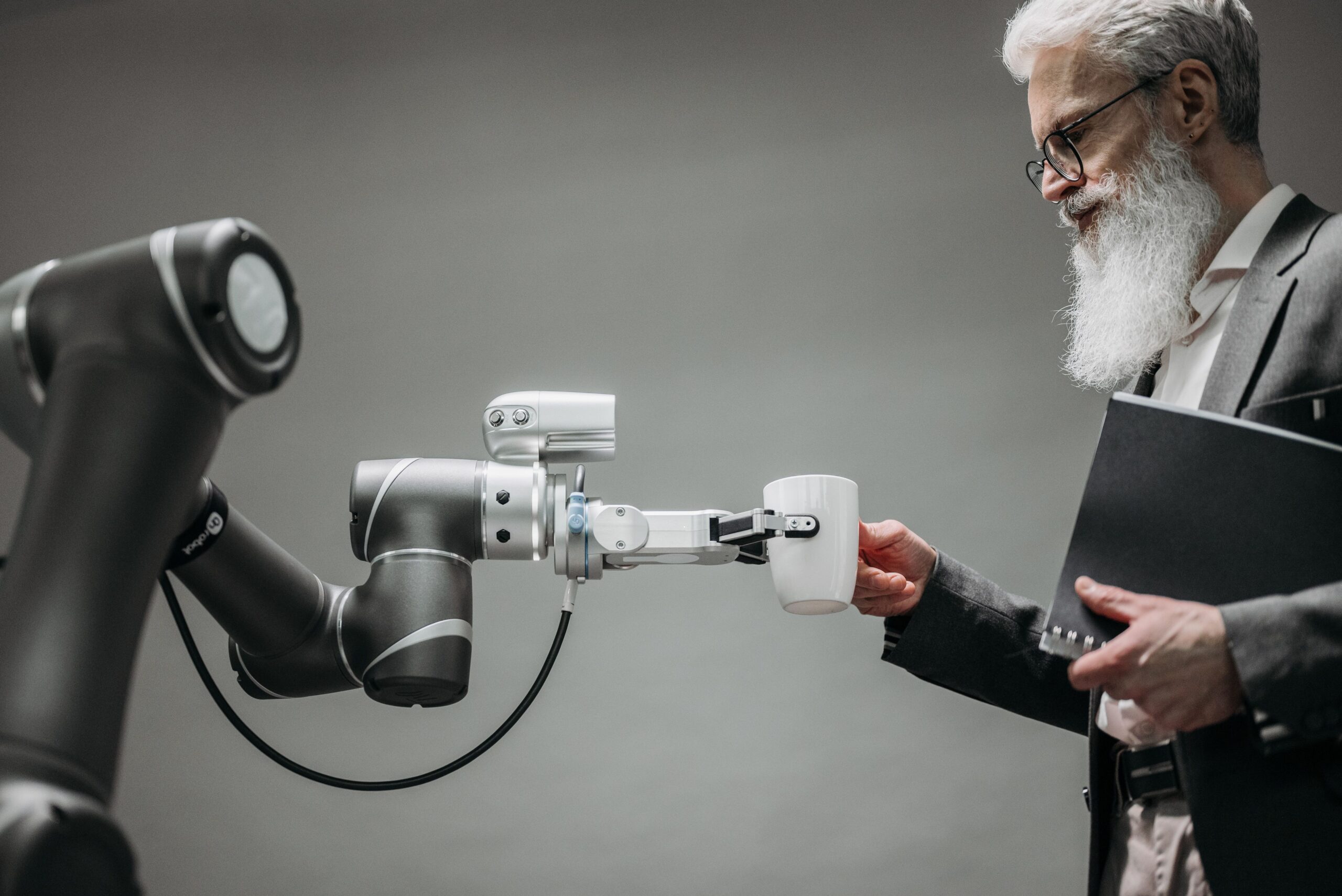
Components of Robot Arm
Robot arms have several interconnected components that help them perform movements, detect surroundings, and perform accurate tasks. Each part has a significant function in providing the needed speed, accuracy, and consistency.
1. Base
The base makes the body of the robot arm and supports the whole structure, and offers stability during the performance of the robot. Some bases are stationary while others are mounted on mobile platforms.
2. Joints and Links
The joints and links of the robot arm connect the body and create a movement that is similar to human shoulder or arm movements, while the number of joints defines the motion capabilities of the robot.
3. Motors
Numerous individuals inquire regarding the type of motors employed by robotic arms.
In current times, robots mainly make use of the following types of motors:
- Servo motors for precise as well as accurate positioning Servo motors make it possible to get outstanding positioning accuracy and speed.
- Stepper motors for controlled motion
- Brushless DC motors for efficiency
- AC servo motors for heavy duty industrial use
Servo motors are the preferred choice for most industrial robotic arm systems because they offer exceptional positioning accuracy and speed.
4. Sensors
Sensors provide real-time feedback that improves safety and performance. Common sensor types include:
- Position sensors
- Vision cameras
- Force and torque sensors
- Laser scanners
- Proximity sensors
These devices help robots detect objects, avoid collisions, and adjust movements automatically.
5. Controller
The controller serves as the robot’s brain, as it obtains commands from software, receives sensor data, and manages all arm movements.
Modern controllers come equipped with AI-based optimization, predictive maintenance, and remote supervision capabilities.
6. End–Effector of a Robot
The end–effector of a robot is connected to the wrist of the robot arm and has a direct impact on the manufacturing product in the industry.
The types of most common end–effectors are as follows:
- Mechanical grippers
- Vacuum suction cups
- Welding torches
- Paint sprayers
- Cutting instruments
- Inspection Camera
- Screwdrivers
The most suitable type of end–effector depends on what the robot has to deal with.
7. Robotic Gripper
A robotic gripper is one of the most common end effectors used in automation.
Popular gripper types include:
- Two-finger grippers
- Three-finger grippers
- Vacuum grippers
- Magnetic grippers
- Soft robotic grippers
Different robot grippers are designed to handle delicate products, heavy metal parts, food items, electronics, or irregularly shaped objects without causing damage.
Robot Arm Applications
Robot arms have transformed nearly every major industry by improving productivity, quality, and workplace safety.
Manufacturing
Manufacturing remains the largest market for industrial robot arms.
Common tasks include:
- Assembly
- Screw driving
- Material handling
- Machine tending
- Quality inspection
- Packaging
Factories benefit from higher production speeds and fewer defects.
Pick and Place Robot
A pick and place robot automatically picks up objects from one location and places them somewhere else.
These robots are widely used for:
- Electronics assembly
- Pharmaceutical packaging
- Food processing
- Warehousing
- Logistics
Because they work continuously with remarkable precision, businesses significantly reduce labor costs and increase throughput.
Robotic Palletizer
A robotic palletizer stacks boxes, bags, bottles, and containers onto pallets for storage or shipping.
Compared to manual palletizing, robotic systems offer:
- Faster operation
- Consistent stacking patterns
- Reduced worker injuries
- Better warehouse efficiency
A palletizing robot is commonly found in beverage plants, food factories, consumer goods manufacturing, and distribution centers.
Robotic Welder
A robotic welder performs highly consistent welding operations with exceptional precision.
Industries using robotic welding include:
- Automotive manufacturing
- Aerospace
- Heavy equipment
- Shipbuilding
- Construction
Robotic welding improves weld quality while reducing exposure to hazardous environments.
Healthcare
Robot arms assist surgeons during minimally invasive procedures and help laboratories automate repetitive testing.
Medical robots continue to expand into rehabilitation, diagnostics, and pharmaceutical manufacturing.
Electronics Manufacturing
Tiny electronic components require extreme precision that human workers often cannot maintain consistently.
Robot arms are widely used for:
- PCB assembly
- Chip placement
- Soldering
- Inspection
3D Printed Robot Arm
A 3d printed robot arm is becoming increasingly popular in education, research, and prototyping.
Benefits include:
- Lower production cost
- Faster design iteration
- Easy customization
- Educational learning projects
Although not as durable as industrial models, they provide an affordable entry point into robotics.
Advantages of Robot Arms
Businesses continue investing in automation because robot arms deliver measurable benefits.
Higher Productivity
Robot arms can operate 24/7 without fatigue, dramatically increasing production capacity.
Exceptional Accuracy
Industrial robots maintain consistent precision, reducing waste and improving product quality.
Improved Safety
Dangerous tasks such as welding, lifting, and handling hazardous materials can be automated, reducing workplace injuries.
Lower Operating Costs
Although the initial investment may be significant, automation reduces labor expenses, minimizes downtime, and lowers long-term production costs.
Flexible Automation
Modern robots can be reprogrammed for new products, making them suitable for changing production demands.
Limitations of Robot Arms
Despite their advantages, robot arms also present certain challenges.
- High upfront investment
- Programming complexity
- Regular maintenance requirements
- Skilled technicians needed
- Limited flexibility in unstructured environments
However, advancements in AI and machine vision are helping overcome many of these limitations.
Buying Guide: Choosing the Right Robot Arm
Before purchasing a robot arm, evaluate the following factors.
Capacity of Payload
Calculate the heaviest load that has to be handled safely by the robot.
Range
Make sure that the arm can get to all areas of work needed.
Freedom Degrees
For the tasks that involve complicated movements, it is best to use a robot with six degrees of freedom. However, some tasks can be done using a robot that has only four or five degrees.
Velocity
Accuracy
Robotic equipment used for precision manufacturing must have a high degree of repeatability.
End Effectors
One should select appropriate robotic gripper sizes, welding equipment, and vacuum cups for the task.
Software Compatibility
Robots should be compatible with existing operations and communication systems.
Maintenance Support
A robot manufacturer should have an efficient service network along with access to spare parts.
Future Trends in Robot Arms
Robot arms are becoming smarter, safer, and easier to deploy.
The new trends are given below:
- Robots controlled by Artificial Intelligence
- Collaborations among robots (Cobots)
- Automation based on vision
- Remote monitoring through clouds
- Forecasting breakdowns
- Digital versions
- Self–operating systems
- Smarter technology for robotic arms
- Affordable automation for small enterprises
Frequently Asked Questions
What do you mean by robot arm?
A robot arm means the artificial machine that is made to steal the job of the human arms. It is the machine that performs tasks like assembly, welding, etc, with precision.
What are the main differences between a robotic arm and industrial robot arm?
A robotic arm stands for any programmable robot arm whereas an industrial robot arm is the special type for the industries that focus on the speed, longevity and constant operation of the robot arms.
What motors are used by robotic arms?
Generally, the motors most used in robotic arms are that of servo motors, stepper motors, and brushes DC motors. Servo motors are used the most commonly in industries where precise motion control is needed along with high speed and repeatability.
What is an end effector of a robot?
An end effector of a robot refers to the device which is connected to the arm of the robot. For instance, the examples are being grippers, welding torches, suction cups, screwdrivers, paint sprayers, and inspection cameras.
To what extent do robotic grippers work?
A robotic gripper is an end effector that enables a robot to grasp, hold and move items. Different grippers may be made to tackle specific matters, such as materials, shapes, and weight.
Which sectors benefit from using robot arms?
Robotic arms applications can be found in automotive, electronics, aerospace, food processing, pharmaceutical, logistics, agriculture, and construction, amongst other industries.
Conclusion
The robotic arm is one of today’s most important advancements in automation technology. It has many industrial applications, such as in pick and place robots, robotic palletizers, and robotic welding equipment, guaranteeing efficiency and accuracy in the workplace. Be it for educational purposes or for manufacturing applications that require a robot with 6 degrees of freedom industrial production, selecting the right system depends on your payload, reach, accuracy, and application requirements. As artificial intelligence, advanced sensors, and collaborative robotics continue to evolve, robot arms will become even more capable, affordable, and essential for businesses seeking long-term productivity and innovation.
